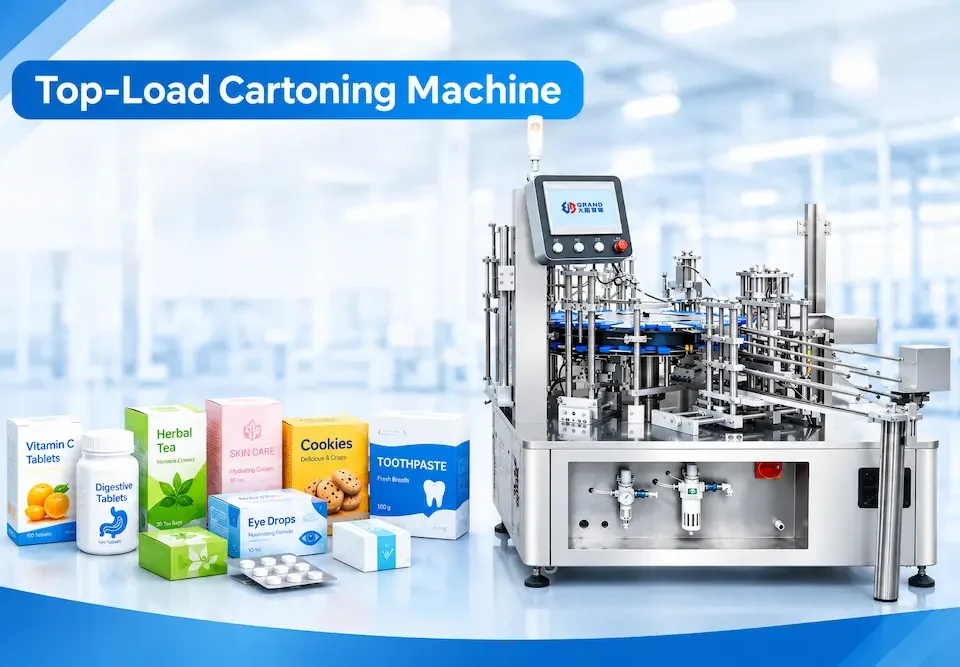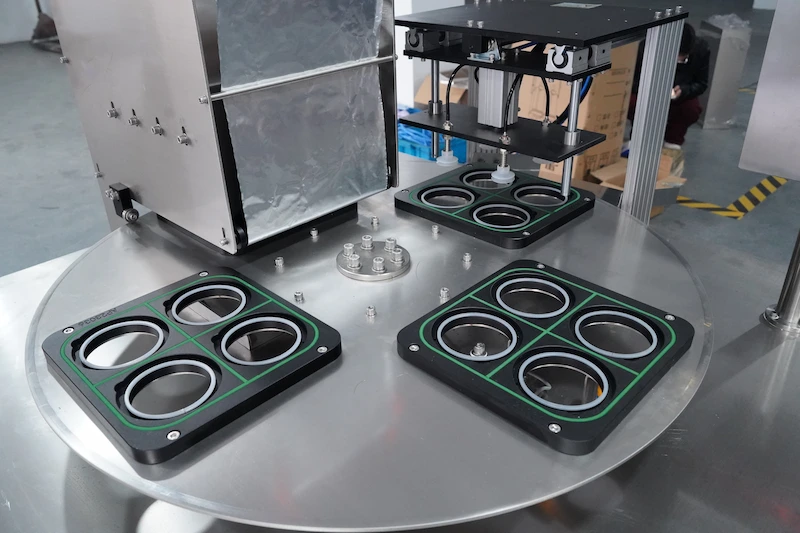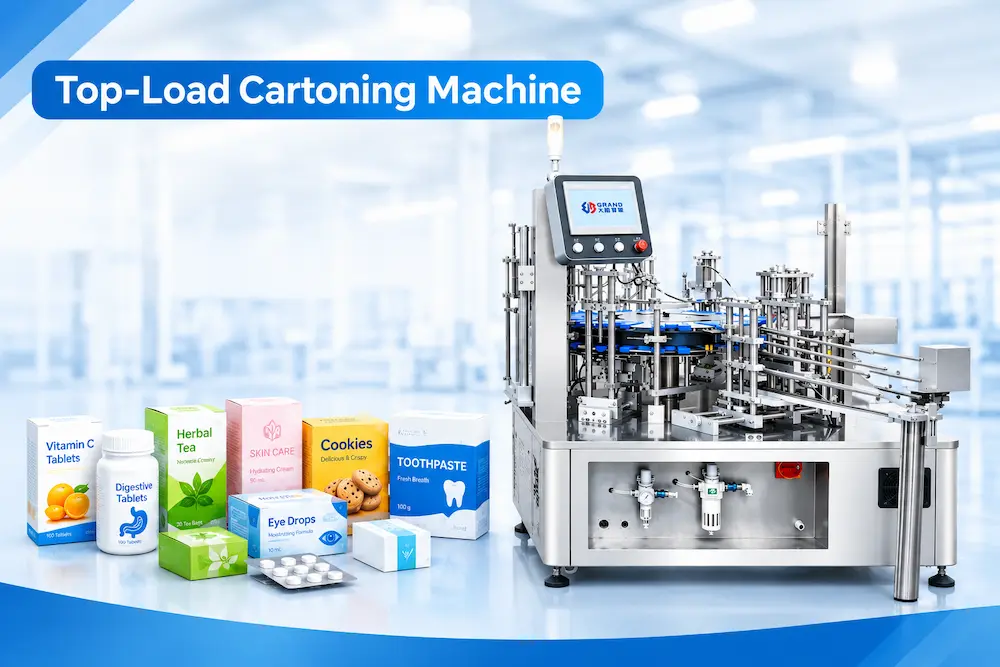

Grand Packaging Machinery на выставке CHPI 2026 в Шанхае: стенд N1C30
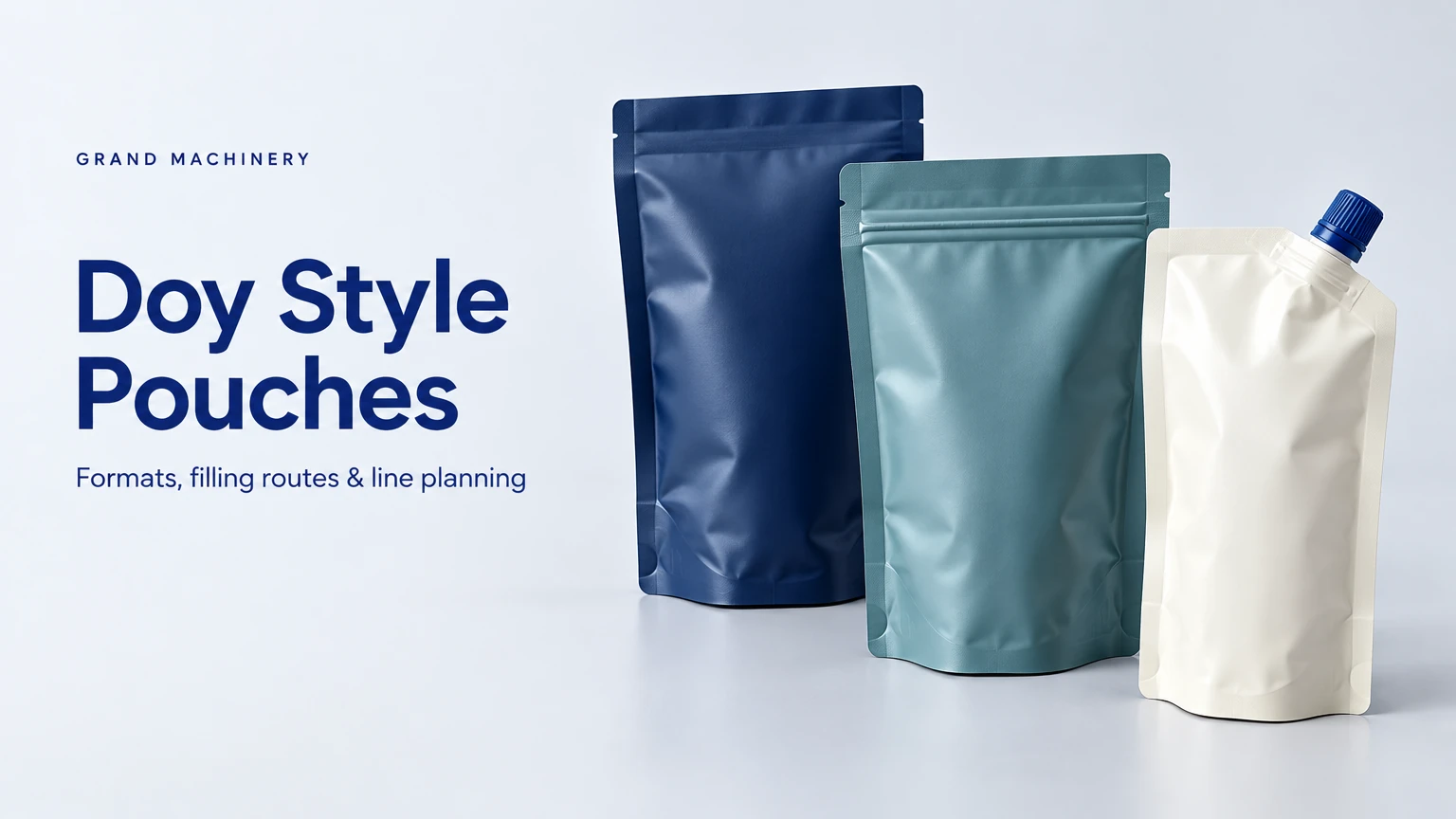
A doy style pouch is a flexible pack with an expandable bottom that helps it stand upright when filled. The term describes the package format. It does not, by itself, identify the filling machine, film construction or sealing process.
For a production project, start with the finished pouch and work backwards: what product goes inside, how the pouch is supplied, how it is filled and closed, and how it reaches its shipping case. This guide explains those choices and the information needed to compare equipment proposals.
What Is a Doy Style Pouch?
The familiar format has front and back panels and a folded bottom gusset. As the pack fills, the base opens to provide support. Its ability to stand depends on the package geometry, material and contents; assess a filled sample rather than judging an empty bag.
“Stand-up pouch” is the broader description. DOYPACK® is a trademark associated with THIMONNIER, whose pouch technology overview describes the distinctive supporting base. In purchasing discussions, a bag drawing and physical sample are more precise than the words “Doypack” or “doy style” alone.
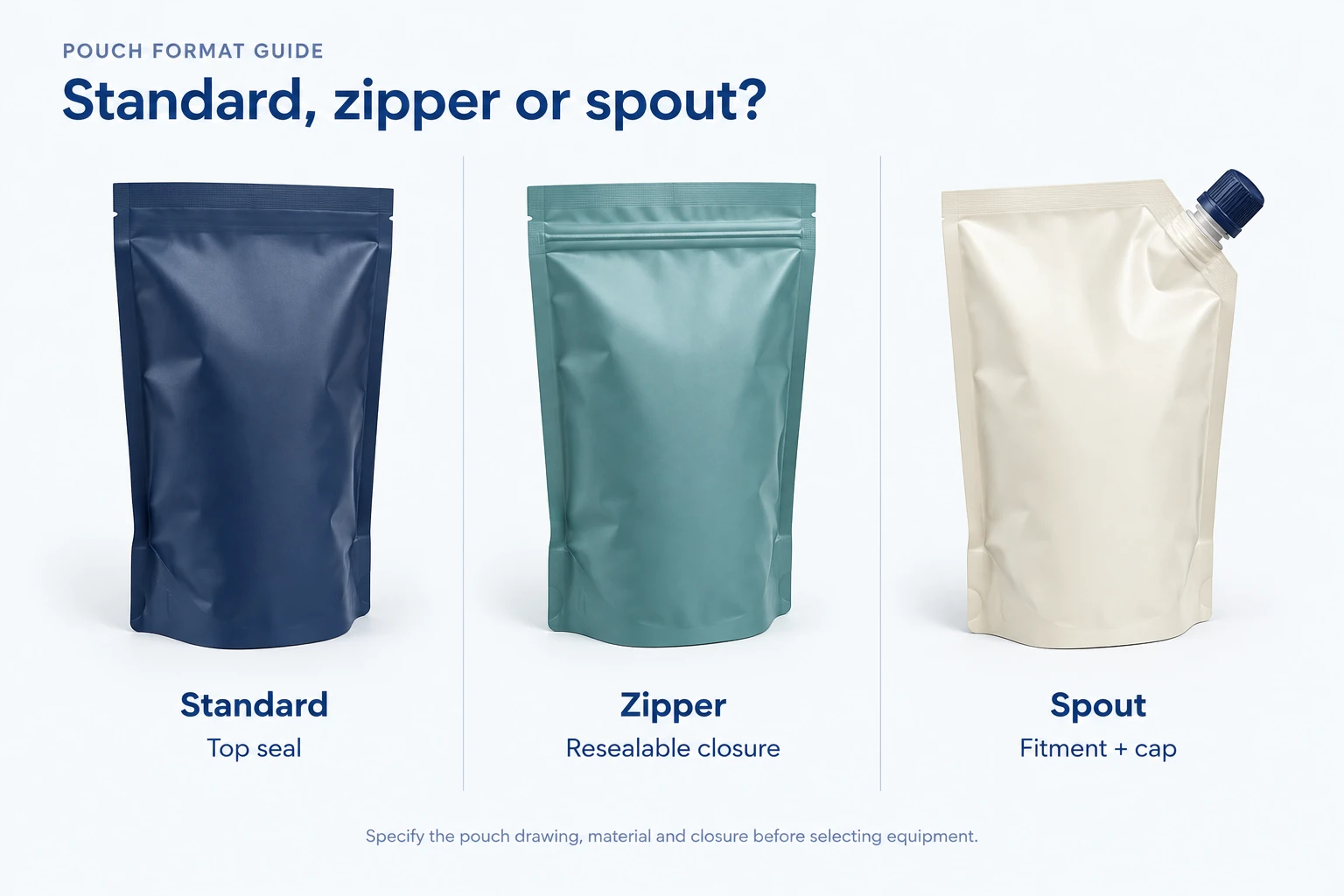
A zipper, spout or shaped outline adds another design choice. These features affect opening, filling access and closure handling. Specify them on the drawing, including their position relative to the top seal and the gripping areas used by the machine.
Pouch Styles: Separate Structure from Features
Swipe horizontally to view all columns.
| Format or feature | What it describes | What to confirm |
|---|---|---|
| Standard bottom-gusset pouch | An expandable base and a top opening for filling | Width, height, gusset definition, seal pattern and filled stability |
| Zipper pouch | A reclosable feature added to the pouch | Zipper opening method, filling clearance and final top-seal position |
| Spouted pouch | A fitment and cap for dispensing or refilling | Spout position, fill-through-spout versus open-top filling, and cap handling |
| Flat-bottom pouch | A distinct base and panel construction | The actual bag drawing and the machine’s approved format tooling |
Windowed, metallized, transparent and paper-look designs describe appearance or material construction rather than a separate filling route. Do not infer moisture protection, oxygen barrier or recycling suitability from the appearance. Ask the pouch converter for the construction and performance data relevant to your product.
A flat-bottom pouch and a curved-bottom-gusset pouch may both stand on a shelf, but their forming and sealing details can differ. A machine demonstration with one format is not a substitute for a trial with the other. Include the intended retail display orientation in your specification.
Rollstock and Premade Pouches Follow Different Routes
The first equipment question is whether the packaging line receives a roll of film or an already converted pouch. Both routes can produce a similar-looking finished pack, but they divide the work differently between the packaging converter and the filling line.
Rollstock form-fill-seal
A form-fill-seal system makes the package from film as part of the production process, then fills and closes it. The selected configuration must include the forming and sealing functions required for the exact gusset, shape and closure. Film roll dimensions, registration marks and print repeat belong in the equipment brief.
Horizontal form-fill-seal is one route for stand-up pouches. It should be distinguished from horizontal flow wrapping around a product: the word “horizontal” alone does not establish the pouch format or machine capability. Ask for a process layout showing where the bag is formed, filled and finally sealed.
Premade pouch filling and sealing
A premade route starts with converted bags. The equipment presents a pouch, opens it, doses the product and completes the closure. Mespack’s premade-pouch description illustrates this distinction between pouch handling and the opening, filling and sealing module.
For an open-top pouch, the top-sealing station needs access to a clean, correctly presented seal area. A pouch filled through an existing spout instead requires suitable fitment handling and closure equipment. Confirm which sequence is being quoted, including who supplies the pouch and any cap or fitment.
Can a vertical machine make doy style bags?
Some can, when equipped for that format. For example, Syntegon’s SVE range includes dedicated vertical Doy-Zip equipment. “VFFS” alone is insufficient evidence that a particular bagger can produce your pouch.
Swipe horizontally to view all columns.
| Route | Packaging input | Questions for the proposal |
|---|---|---|
| Rollstock FFS | A specified film reel | Which forming, gusseting, closure and sealing functions are included? |
| Premade, open-top filling | Converted pouches with a filling opening | How are bags opened, supported, dosed and top-sealed? |
| Premade, through-spout filling | Pouches with fitted spouts | How are fitments located, product dosed and caps applied? |
Match the Product, Pouch and Dosing System
Stand-up formats are used for dry foods, sauces, personal-care products and household refills. Those are packaging applications, not proof that one machine can handle every product. A useful enquiry describes what reaches the dosing system and how it behaves during filling.
- For powders or granules, describe flow behaviour, dust, particle size and the target quantity. Ask how the proposed dosing arrangement keeps product out of the seal area.
- For liquids or viscous products, provide viscosity at filling temperature, particles, foaming and dripping behaviour. Request a review of nozzle access and withdrawal.
- For discrete pieces, give dimensions, fragility and the required count. Discuss orientation, drop height and the evidence needed to accept the filled pack.
- For products requiring a special hygienic process, define the process and documentation requirements separately from the bag shape.
If quantity is specified by mass, use mass throughout the acceptance specification. If it is specified by volume, state the relevant temperature and density information. A pouch’s nominal volume does not establish the weight or practical fill level for every product.
Before selecting machinery, agree what an acceptable filled sample looks like: usable headspace, closure access, pack stability and the intended consumer opening. Review the smallest and largest formats in the range, rather than approving the whole range from one convenient sample.
Sealing: Specify a Process Window and a Test Plan
For heat-sealed constructions, temperature, contact time and pressure must suit the material and joint. The pouch converter’s recommendations provide a starting point; production trials establish settings for the actual machine, speed and package. A single temperature copied from another pouch is not a useful specification.
ASTM F2029 addresses laboratory preparation of heat seals and explains the limits of transferring laboratory results to manufacturing. Its scope does not replace production-equipment validation or cover every aspect of seal integrity. Agree the relevant checks with the packaging specialist before the trial.
Record the material identification, pouch format, fill condition, machine settings and test method together. Separate seal appearance, seal strength and leakage requirements; passing one check does not automatically establish the others. Include the closure and any gusset intersections that deserve particular attention.
When comparing controls, ask for the functions you need: adjustable sealing settings, recipe handling, fault indication and the response to a missing or unopened pouch. Request the proposed component list. A PLC, servo or sensor brand name does not establish those functions or prove a package-quality result.
Plan the Line Beyond the Filling Machine
Describe how the finished pouch leaves the filling station: standing or lying down, individually spaced or accumulated, and with what variation in shape. Soft packs can change shape with their contents, so downstream handling should be reviewed using filled samples.
Weight inspection is a separate decision. Grand Machinery’s automatic checkweigher range is a starting point for comparing package weight, conveyor conditions and rejection requirements. Confirm the transfer and weighing arrangement for your specific filled pouch. Weight inspection does not replace seal testing.
Decide whether pouches go directly into a shipping case or first into retail cartons. If you need secondary cartons, review картонажное оборудование against the pouch support, insertion direction and carton drawing. Where cartoned products then enter shipping cases, include downstream handling and case loading in the production-line review. Direct loading of loose pouches requires its own handling assessment.
Express the target in good finished packs per minute and show the pack count at every stage. For example, a planning target of 60 pouches per minute with 12 pouches per shipping case requires an average of 5 cases per minute before allowing for stops. This arithmetic is a planning example, not the rated output of any machine.
Include replenishment, changeovers, rejected packs and transfer interruptions in the capacity discussion. Agree where the output is measured and how the acceptance run counts interruptions. This makes quotations easier to compare than separate headline speeds for unrelated operations.
A Practical Workflow for Equipment Selection
Use the following activity flow to move from a package idea to an agreed equipment scope. Unresolved compatibility or trial results return to the design review before the purchase specification is approved.
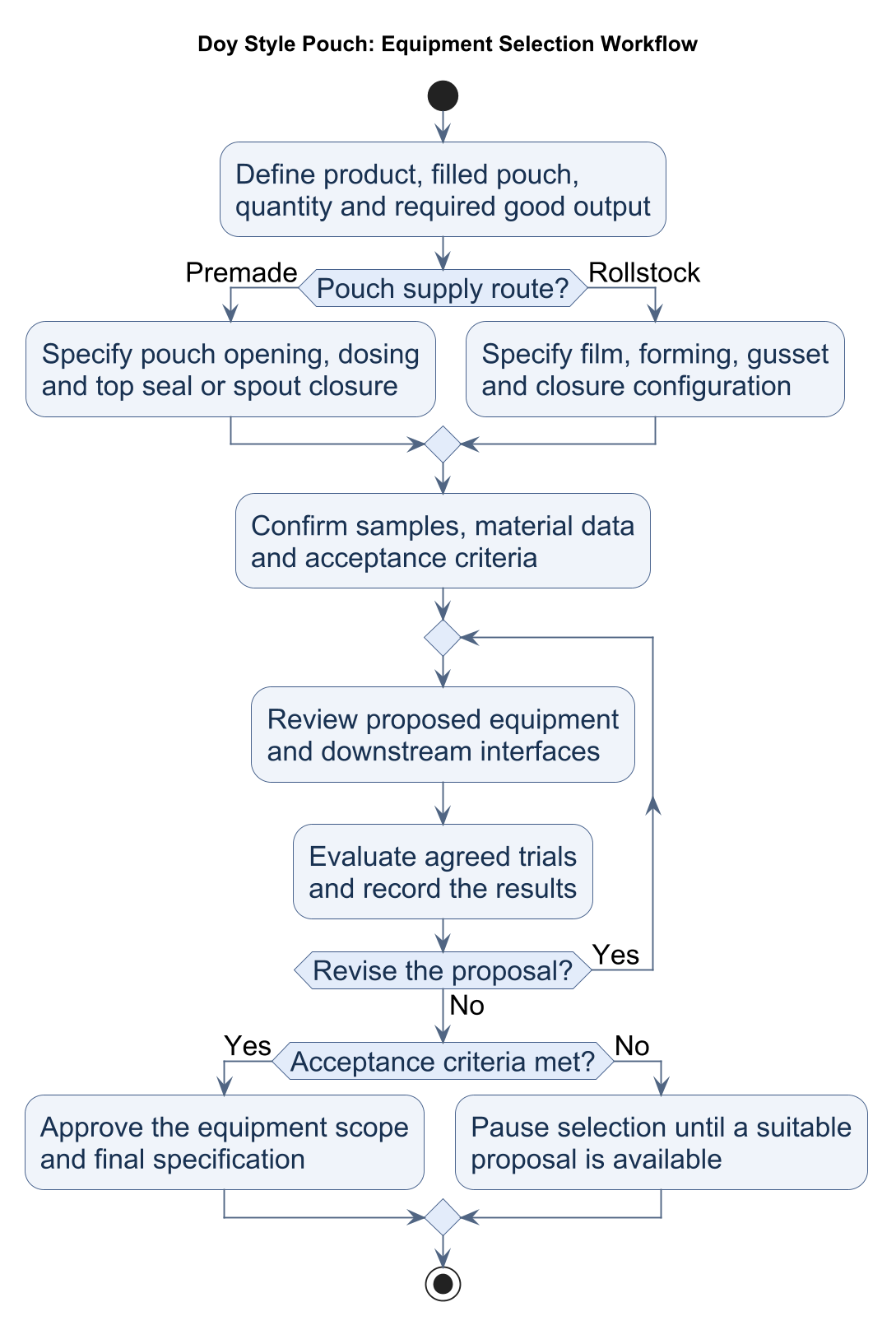
Text alternative: define the product and filled pouch → select rollstock or premade supply → review the proposed filling and closure route → confirm sample and material compatibility → evaluate agreed trials and line interfaces → approve the scope, revise it, or pause the selection.
What to Send with Your Enquiry
Swipe horizontally to view all columns.
| Information | Useful detail |
|---|---|
| Product | Physical form, filling temperature, flow or viscosity information, particles and target quantity |
| Pouch | Drawing, filled sample, dimensions, gusset definition, zipper or spout details and material construction |
| Production | Required good output, batch sizes, format changes, operating hours and replenishment method |
| Interfaces | Infeed and discharge orientation, conveyor heights, carton or case pattern and available layout |
| Acceptance | Trial samples, measurement methods, acceptable rejects, documents and responsibilities |
Compare proposals against the same brief. Ask each supplier to identify the included equipment, format parts, dosing system, controls, utilities and service scope. Keep optional equipment and unresolved items visible in the quotation so that price comparisons refer to equivalent requirements.
For a wider project, start with the Grand Machinery packaging equipment overview. Separate primary packaging from the later cartoning, inspection and shipping stages. Select the required stages around the finished pack and confirm the interfaces before ordering.
Часто задаваемые вопросы
Is every stand-up pouch a doy style pouch?
Stand-up pouch is a broad description. Buyers use “doy style” for a familiar bottom-gusset format, while other standing formats have different bases and panels. Use the bag drawing to define what must be produced or handled.
Does a zipper replace the final top seal?
A zipper is a reclosure feature. The final packaging design must separately define the initial closure, opening method and required integrity. Confirm the complete closure sequence with the pouch supplier and equipment provider.
Is premade pouch filling always slower than rollstock FFS?
There is no useful universal speed ranking. Compare the proposed configurations with the same product, bag, quantity, closure and acceptance conditions. Include good output and changeover requirements, not only empty-cycle speed.
Can an existing machine run a new pouch material?
Request an assessment and trial before assuming compatibility. Material construction can change forming, handling and sealing behaviour. Check whether different settings, tooling or other changes are needed for the new material.
What is the best first step when the machine model is unknown?
Prepare the product and pouch brief first. Contact Grand Machinery with your samples, finished-pack requirements and line layout. This gives the team a concrete basis to review the proposed equipment scope and the next technical checks.