
Blister Leak Test: Methods and Acceptance Criteria
Blister Sealing Temperature: Heat Seal Process Window
Respuesta rápida: There is no universal blister sealing temperature. DB Packaging specifies 170–180°C for its pharmaceutical lidding foil under stated pressure and dwell conditions. Use supplier data to develop a machine-specific heat-seal window. Confirm the selected settings through representative trials, seal-strength testing, package-integrity checks and appearance inspection.
This guide focuses on pharmaceutical tablet and capsule blisters made with thermoformed plastic or cold-formed aluminum-based materials. Published material data are identified by source. The worked trial matrix is hypothetical, not GRAND test data or a release specification.
1. What Is the Correct Blister Sealing Temperature?
Blister sealing temperature is the thermal setting used to bond the lidding material to the flange of the formed web. The finished pack depends on a continuous seal around each pocket. During heat sealing, the approved coating or polymer layer must reach suitable bonding conditions while the two surfaces are in contact. The temperature shown on the machine’s controller is only one part of this process.
There are three different temperatures to distinguish: the temperature set on the controller, the actual temperature of the sealing surface, and the temperature reached at the interface between the lidding and forming material. They need not be the same. A heater sensor can report a stable value while the bonding interface receives less heat than expected, particularly after a speed change or when a different laminate is introduced.
For a documented example, DB Packaging recommends 170–180°C for its pharmaceutical lidding foil, with a contact time of 0.25–0.5 s and sealing pressure of 2.8–5.6 kg/cm² (40–80 lb/in², as reported by the supplier; reference 1). These are conditions for that supplier’s material, not GRAND machine settings or a general PVC or Alu-Alu specification. Confirm the material grade, measurement point and sealing mechanism before trials.
Forming and sealing temperatures also serve different purposes. Forming makes the cavity; sealing joins the lid around that cavity. Our thermoforming blister machine guide explains the equipment sequence in more detail.
2. Temperature, Pressure and Dwell Time
Temperature, pressure and dwell time work together. A short contact interval may transfer less heat to the bonding layer. Insufficient contact pressure can leave parts of the seal land unbonded, even if the heater is operating at the expected temperature. Excess heat or pressure can deform the materials. Changing one setting alone does not establish the cause of a seal failure.
| Parámetro | What it represents | If the effective value is insufficient | If excessive |
|---|---|---|---|
| Temperatura | Thermal condition at the bonding interface; machine display is an indirect measure | Incomplete activation of the coating; weak or discontinuous bond | Possible distortion, coating degradation or lidding damage |
| Presión | Contact force per unit area of the intended seal land | Gaps or uneven bond formation | Material marking, deformation or tooling-related damage |
| Dwell time | Effective interval of contact under the sealing conditions | Insufficient heat transfer or bond formation | Unnecessary heat exposure or reduced throughput |
Web speed is a related operating variable: a change in speed or index timing can alter the effective contact interval and the thermal load on the sealing station.
Pressure needs particular care. A pneumatic supply gauge is not automatically a measurement of the pressure at the sealing interface. Tool geometry, actuator area, contact distribution and mechanical alignment can affect the load delivered to the packaging material. Verify the meaning of each machine parameter with its supplier and approved documentation.
3. Sealing Different Blister Materials
Always identify the actual mating layers rather than choosing a temperature from a generic list of plastics. PVC, PVDC-coated structures and cold-form laminates can differ in heat transfer and sealing behavior. The lidding foil also varies in coating chemistry, coating weight, temper and construction.
| Blister construction | What contacts the heat-seal layer | What must be confirmed |
|---|---|---|
| Aluminio-PVC | PVC sealing surface | Lidding lacquer compatibility and film distortion limits |
| PVC/PVDC laminate | Actual specified sealing face (varies by construction) | Coating orientation, material grade and qualified seal conditions |
| Cold-formed Alu-Alu | Polymer sealing layer of the formed laminate | Layer construction, contact pattern and compatibility; cold forming does not eliminate the heat-sealing step |
| Peelable / supported lidding | Specified coated or laminated lidding structure | Opening behavior, thermal response and seal strength limits for that product |
In a 2012 study, Mühlfeld and colleagues compared two heat-seal lacquer types at different coating weights while varying sealing temperature, pressure and time. Higher lacquer weights increased seam strength, but helium leakage results changed only slightly. In the tested cold-formed blisters, the higher weights were also associated with greater moisture uptake (reference 2). Evaluate mechanical strength, integrity and moisture protection separately when changing lidding materials. The study does not identify a universal coating weight or production setting.
Use the material supplier’s approved documentation to confirm the sealing side of each web, the permitted material combination, any heat exposure constraints and the intended opening behavior. Reassess these inputs when a supplier, material grade or lidding structure changes.
4. Plate vs. Roller Sealing
A flat-plate station typically applies heat and pressure during a defined contact interval as the web indexes. A rotary station uses rolling contact, and its effective contact duration depends on the machine’s geometry and motion. The same numerical heater setting cannot be transferred between these mechanisms without evidence that their sealing results remain acceptable.
In the left schematic, a heated platen presses the lidding foil against the flat sealing lands while a matching lower die supports the formed web and provides clearance for the filled pockets. In the right schematic, a heated sealing roller and a recessed counter-roller transport the web through their contact zone. The recesses accommodate the pockets; the films bond at the supported sealing lands. Orange highlights the bonding interface. These are conceptual cross-sections, not drawings of a specific GRAND model. Compare temperature control, web contact and speed response for the proposed equipment. For a flat-plate arrangement, check alignment and uniform support at the seal land. For a rotary arrangement, ask how roller contact, web speed, registration and temperature stability are controlled. Confirm the actual station design for the selected equipment.
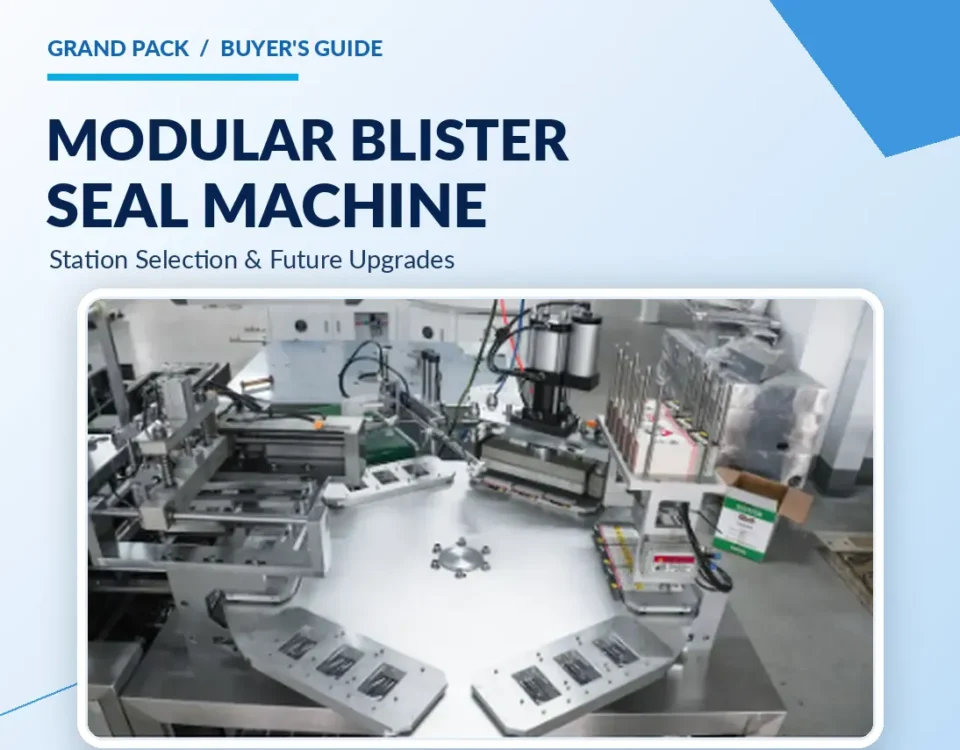
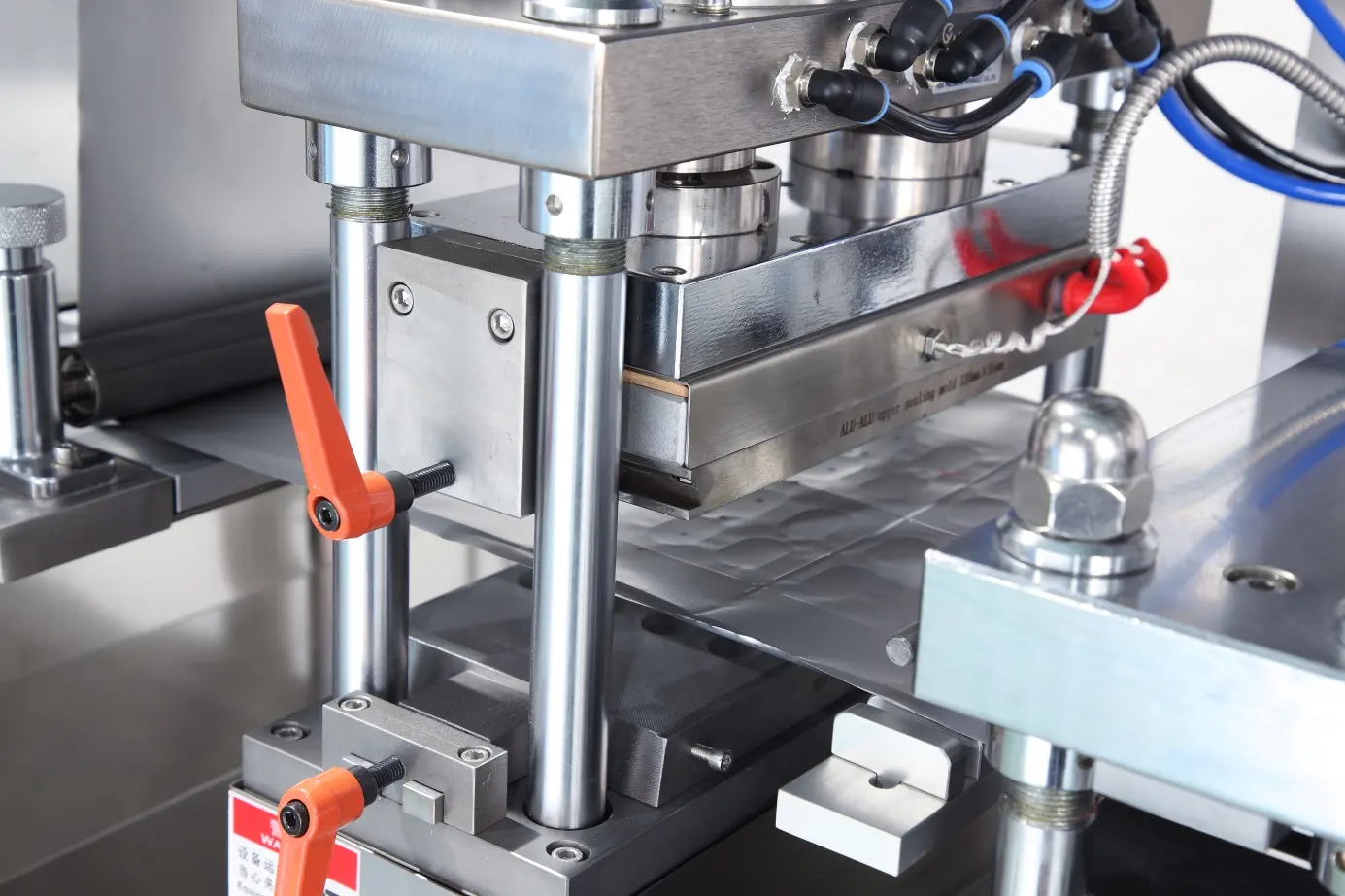
GRAND’s DPP-260Y product page includes a heat-sealing mold among its listed components. It does not publish a qualified sealing temperature for a particular material or product. Use the proposed sealing configuration and pack drawing for trial planning. The following photograph is a separate station reference from the GRAND media library; it does not establish the DPP-260Y’s exact configuration.
5. How to Develop a Heat Seal Process Window
A process window is a set of acceptable operating conditions for the intended package and equipment. It should describe the relationship among temperature, contact time, pressure, production speed and material attributes. A single passing trial cannot establish the window or its robustness.
ASTM F2029-16(2021) describes laboratory heat-seal preparation and assessment using seal-strength measurements for flexible barrier materials. Its scope covers hot-bar and impulse laboratory sealing, and does not establish production-machine validation procedures. Treat a lab sealability study as an input to equipment-specific development, not a finished validation (reference 3).
- Define the pack and quality requirements. Fix the format, material grades, lid construction, opening mechanism and appropriate test criteria.
- Verify measurement and tooling. Confirm the controller and sensor status, tooling alignment, contact conditions and the meaning of recorded pressure and dwell.
- Design the trial. Select authorized trial levels around the material and equipment supplier’s recommended starting point. Include the intended production speed and representative web positions.
- Test the resulting packs. Assess appearance, mechanical seal performance and package integrity as appropriate. Include repeat observations and location-specific samples.
- Confirm a repeatable operating region. Investigate the edges of the acceptable region and expected variation. Quality and engineering teams should approve the limits and qualification plan before routine use.
ASTM F88/F88M-23 measures the force associated with separating a seal specimen and describes the failure mode. Use a suitable test geometry and method for the blister material and product. A strength result cannot independently establish leak-tightness. See our separate blister leak test guide for integrity-test selection and limitations.
6. Worked Example: Interpreting Trial Results
Illustrative trial only: Assume an engineer selects an approved development reference heater setting T0 and a temperature increment ΔT, then evaluates three contact times while holding a defined pressure condition and other relevant variables constant. The example below shows how a trial matrix could be recorded. The outcomes are hypothetical and illustrate how to interpret a trial; no factory measurements or recommended operating values are implied.
| Heater setting relative to reference | Shorter dwell | Reference dwell | Longer dwell |
|---|---|---|---|
| T0 − ΔT | Fail: weak bond | Fail: weak bond | Pass in trial |
| T0 | Fail: weak bond | Pass in trial | Pass in trial |
| T0 + ΔT | Pass in trial | Pass in trial | Fail: distortion |
Five of the nine hypothetical cells meet the assumed trial criteria. The middle setting with reference dwell is a reasonable candidate for further study, since adjacent combinations also pass. Treat the central combination as a candidate for further qualification, not an approved production setting. The pressure dimension, material-lot variation, speed, repeated samples, measurement uncertainty and longer-run behavior still require assessment.
Record the actual machine display, measured temperature where available, dwell, pressure indication, speed, web position, material lot, individual test outcomes and observed failure modes. Preserve failed trial data rather than removing them from the record. When conditions change, collect fresh samples according to the approved development or investigation plan.
7. Diagnosing Heat-Sealing Problems
If a sealing problem appears, compare the pattern of defects with recent process changes before altering the heater. Is it restricted to one lane? Did it begin after a material change, startup or speed increase? Does a temperature display remain steady while the seal outcome changes? These observations guide the investigation.
| Observed pattern | Check before changing temperature | Evidence to collect |
|---|---|---|
| Weak seals across the entire web | Coating compatibility, actual thermal response, pressure and dwell | Material lot details, temperature trend and seal test results |
| Failure at one lane or pocket position | Seal land condition, alignment, uneven pressure, local contamination | Pocket location map, tooling inspection and samples |
| Good seal at startup; weak seal after speed increase | Effective contact time and temperature stability at load | Speed history, controller trends and timed samples |
| Wrinkled foil or warped cards | Web tracking, tension, heat exposure and support tooling | Foil tracking record and defect photographs |
| Unexpected peel or opening force | Lidding specification, test method and failure mode | Force results, material certificates and opening assessment |
Use the approved operating and safety procedures before inspecting heaters, rollers or tooling. Stop and isolate the equipment when physical intervention requires it; never defeat a guard or interlock to inspect a moving or heated station. Adjustments affecting a qualified process must follow the site’s change-control and quality procedures.
Nuestras blister packaging defects guide addresses additional causes outside the heat-sealing station, including forming damage, feed problems and cutting faults.
8. Machine Selection and Acceptance Checks
When comparing blister packaging machines, include seal-process evidence in the technical specification rather than asking for a nominal temperature range alone. A suitable acceptance plan connects the equipment’s controls and tooling to the exact materials and finished-pack quality requirements.
| Requirement | Evidence to request |
|---|---|
| Material and pack compatibility | Approved forming and lidding specifications, format drawing, representative samples |
| Sealing station | Actual mechanism, contact area, tooling and temperature control arrangement |
| Process monitoring | Meaning of displayed parameters, measurement points, recording capability and alarm behavior |
| Trial conditions | Target production output, authorized settings, sampling across web positions and time |
| Acceptance evidence | Agreed test methods and limits, representative trial records and responsibilities for follow-up qualification |
Prepare your product dimensions, blister drawing, forming and lidding material specifications, intended output and acceptance requirements when discussing equipment. Explore GRAND’s blister packaging machine range to identify the relevant configuration and confirm how your packaging trial will be assessed. Factory acceptance testing does not replace the customer’s required site qualification.
9. Preguntas frecuentes
What is the ideal blister sealing temperature?
There is no universal ideal temperature. Use the material and equipment suppliers’ documented starting conditions and establish the approved temperature, dwell and pressure window for the actual package.
Is 180°C suitable for every PVC blister pack?
No. Some suppliers publish starting conditions around that value for particular lidding foils, but the coating, PVC grade, tooling, contact time and measurement point matter. A value from one material specification is not a qualified recipe for another.
Does increasing the sealing temperature improve seal strength?
It may improve bonding when the interface receives insufficient heat, but excessive thermal exposure can damage materials or change opening behavior. Check the full process and verify the resulting packs.
Why does seal quality change when blister machine speed increases?
A speed change may affect effective contact time, temperature recovery or web tracking, depending on the equipment design. Compare the actual conditions and quality results before and after the change.
Does cold-form Alu-Alu blister packaging require heat sealing?
Cold forming creates the cavity without a thermoforming heating step. The lidding and formed laminate may still require a compatible heat-sealing process. Verify the exact material construction and closing method.
Can a seal-strength test replace a blister leak test?
A strength test evaluates mechanical separation of a specimen. An integrity test evaluates the relevant leakage condition. Use the appropriate qualified methods for the product requirements.
Conclusión
Reliable blister sealing starts with compatible materials and a controlled combination of temperature, pressure and dwell time. Establish the process window using representative trials, assess the appropriate quality attributes and confirm performance at the intended production speed. When evaluating equipment, ask for the evidence needed to qualify the actual pack instead of relying on a generic sealing temperature.
Referencias
- DB Packaging. Pharmaceutical blister lidding foils: published product specifications and recommended operating conditions.
- Mühlfeld L, Langguth P, Häusler H, Hagels H. Influences of heat seal lacquer thickness on the quality of blister packages. European Journal of Pharmaceutical Sciences. 2012;45(1–2):150–157. DOI: 10.1016/j.ejps.2011.11.006.
- ASTM International. ASTM F2029-16(2021): laboratory heat-seal preparation and sealability assessment.
- ASTM International. ASTM F88/F88M-23: seal strength of flexible barrier materials.
Desarrolle su negocio con Grand