
Trapped Blister Packaging With Folded or Two-Piece Cards
Capsule Filling Weight Variation: Causes and Solutions
Réponse rapide : Capsule filling weight variation is the difference in net fill mass between individual capsules or sampling periods. Start by separating weighing error, a shift in average weight and increased variability. Then compare powder feed, dosing conditions and equipment records with the approved process. A stable average alone does not demonstrate consistent individual fills.
This guide focuses on powder-filled two-piece hard capsules in industrial production. The worked weight and RSD examples are illustrative calculations. Published experimental results are separately identified and cited; neither represents GRAND production test results or pharmaceutical acceptance limits.
What Is Capsule Filling Weight Variation?
Capsules from the same batch may differ in the mass of their contents. In manufacturing, this can appear as a consistent underfill or overfill, a wider distribution of weights, a gradual drift, or a periodic change related to production events. These patterns require different investigations.
Distinguish three measurements: gross capsule weight includes the shell; net fill weight measures the contents; active ingredient content measures the drug substance itself. They are not interchangeable. Even an apparently consistent fill mass cannot establish dose uniformity when the blend is not homogeneous.
| Measurement | Ce que cela décrit | Pourquoi c'est important |
|---|---|---|
| Poids brut | Filled capsule including shell | Useful for screening when the method is qualified. |
| Net fill weight | Mass of material inside the capsule | Separates the fill from shell mass. |
| Active ingredient content | Amount of a particular drug substance | Requires the applicable validated method or permitted compendial procedure. |
How to Measure Net Fill Weight and RSD
Use a suitable calibrated balance, identify each sample and follow the approved weighing procedure. When an individual empty shell and its filled counterpart can be matched, subtract the shell mass to obtain the net fill. For destructive testing, use the site’s approved emptying and shell-weighing method. Avoid applying a generic tare value without establishing that it is appropriate.
Net fill weight (mg) = filled capsule mass − empty shell mass. A capsule weighing 620 mg with an empty shell mass of 120 mg has a net fill of 500 mg.
Mean deviation and relative standard deviation
Average net fill weight indicates whether the process is centered on its target. Relative standard deviation (RSD) measures dispersion relative to that average.
Mean deviation (%) = (sample mean − target) ÷ target × 100.
RSD (%) = sample standard deviation ÷ sample mean × 100. The sample standard deviation uses the sum of squared differences from the mean divided by n − 1 before taking the square root.
Worked example: two groups with a 500 mg target
| Métrique | Group A | Group B |
|---|---|---|
| Individual net fills (mg) | 490, 495, 500, 505, 510 | 475, 477, 480, 483, 485 |
| Mean (mg) | 500 | 480 |
| Mean deviation | 0.0% | −4.0% |
| Sample standard deviation (mg) | 7.91 | 4.12 |
| RSD | 1.58% | 0.86% |
Illustrative example: Net fill weight comparison
Group A is centered on the 500 mg target but has a wider spread. Group B is more repeatable yet shifted below target. For Group B, investigating the established dosing setup and measurement system may be more useful than attempting to reduce variability alone. Neither group is assigned a pass or fail here: these five-value examples demonstrate statistics, not a release test or recommended sample size.
Recognize Weight Variation Patterns Before Adjusting the Machine
| Observed pattern | Possible explanation | Evidence to check |
|---|---|---|
| Mean shifts but spread remains similar | Changed dosing setup, blend packing or tare bias | Setup records, blend lot and balance verification. |
| Average is close to target, but individual weights scatter | Irregular feed, inconsistent powder packing or intermittent transfer | Individual weights, powder bed observations and rejects. |
| Weight drifts over a run | Changing feed condition, material behavior or component condition | Time-stamped weights, refill events and process trends. |
| Repeated low or high values | A repeatable event or position-related issue | Cycle or position records where traceability is available. |
| Gross weights vary while net fills remain stable | Shell mass variation | Matched shell and fill measurements. |
The patterns are starting hypotheses, not proof of a specific cause. Time or machine-position records can help narrow the investigation, but do not assume all capsule fillers provide station-level tracking.
Common Causes of Capsule Filling Weight Variation
| Cause group | What can happen | Practical investigation |
|---|---|---|
| Measurement system | Incorrect tare, balance drift or inconsistent sampling | Verify balance checks, method and sample identification. |
| Propriétés matérielles | Cohesion, density or flow changes alter powder packing | Compare approved blend test results and lot history. |
| Powder supply | Uneven delivery or bed height changes dosing conditions | Compare feed level, refill timing and qualified process records. |
| Dosing components | Wear, incorrect format parts or setup alter metering | Inspect against the manufacturer’s drawings and approved setup. |
| Transfer and ejection | Incomplete transfer or residue affects filled mass | Review retained samples, visible residue and reject patterns. |
| Operating conditions | Changes after setup or restart alter the process | Review time-stamped settings and qualified operating ranges. |
Do not compensate for a suspected defect by making uncontrolled changes to production settings. Follow the manufacturer’s safety instructions and the site’s approved procedures. A broader overview of operator, shell and cleaning issues is available in our guide to common capsule filling machine operation mistakes.
How Powder Flow and the Dosing System Affect Fill Weight
Powder characteristics
In a peer-reviewed study of a continuous nozzle dosator filler, Osorio and Muzzio found that the measured flow properties of finished blends were related to both fill weight and weight variability. Their findings support characterizing the actual blend rather than relying only on the nominal capsule volume. The study was performed on an MG2-G140, not a GRAND machine.
Dosing disc and tamping conditions
A separate study of the In-Cap automatic tamping-type filler investigated pin positions, powder bed height, machine speed and shell type. The pin setup affected fill weight and variability, while bed height was important for the poorly flowing materials tested. These results were equipment- and formulation-specific; they do not establish universal pin settings or operating speeds.
In the low-speed tests on the In-Cap, Nair and colleagues reported a fill-weight coefficient of variation (CV, also called RSD) of 3.3% for size #0 capsules and 7.1% for size #00 capsules filled with a poorly flowing drug blend. This comparison illustrates why formulation and capsule format should be evaluated together; it does not isolate capsule size as the sole cause or establish a performance limit for other fillers.
Capsule Fill Weight Variability
Published experimental results · poorly flowing drug blend · In-Cap filler at low speed
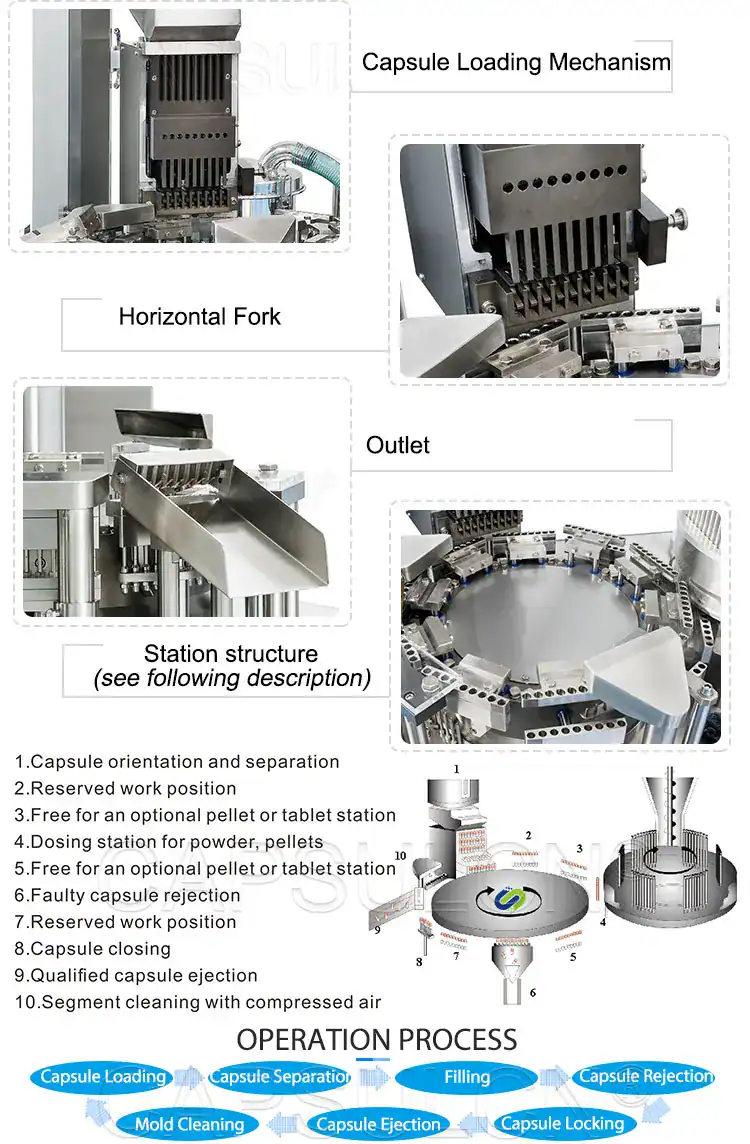
For a dosing-disc machine, the appropriate powder delivery, metering and transfer conditions must be evaluated together. Check the condition and identity of installed format parts and compare process records with the approved recipe. An appropriate equipment investigation should consider the actual dosing mechanism rather than treating a dosator and a tamping system as identical.
For background on the broader production sequence, see our capsule filling machine working principle guide. This article focuses on the weight measurements and diagnosis rather than repeating the machine’s entire station sequence.
A Practical Capsule Weight Variation Troubleshooting Workflow
- Confirm the measurementVerify balance, tare method and sample identity.
- Contain the affected materialFollow site procedures for segregation, escalation and investigation.
- Identify the patternCompare time, machine position, refill events and formulation lots.
- Check one suspected cause at a timeUse approved checks on powder supply, dosing parts and operating records.
- Verify recoveryResample against the approved criteria and document the result.
When a weight result is outside the approved in-process limit, the applicable deviation, material-control and quality procedures govern what happens next. Retain records of the affected production interval. Only authorized personnel should perform adjustments, and any return to routine production should follow the approved verification and disposition process.
In-Process Quality Control and Capsule Weight Variation Testing
For finished pharmaceuticals subject to US cGMP, 21 CFR 211.110 identifies capsule weight variation as one of the in-process controls to address where appropriate. Sampling and specifications should be defined in the written procedure and related to the final product requirements.
Routine net fill measurements, mean deviation and RSD are useful process indicators, but they are not automatically equivalent to a pharmacopoeial uniformity-of-dosage-units test. USP General Chapter <905> distinguishes content uniformity from the weight variation procedure, which is permitted only in specified circumstances. For example, the USP harmonized text effective August 1, 2023 identifies a weight-variation option for a drug substance in a hard capsule when the substance is present at a minimum of 25 mg and represents at least 25% of the contents by mass, subject to applicable requirements. Other active substances may require separate content-uniformity testing. The compendial procedure uses assay information and its own calculations; the simple net-weight examples above are not a substitute. Use the current applicable chapter, monograph, approved procedure and product requirements.
There is no single acceptable percentage deviation applicable to every formulation and machine. Do not interpret a vendor’s mechanical filling accuracy specification as a universal regulatory limit.
What to record during routine weight checks
| Record | Reason |
|---|---|
| Time and batch identification | Relate the result to the affected production period. |
| Individual gross and net weights, as applicable | Separate average shifts from individual variability. |
| Target and approved limits | Evaluate data against the authorized criteria. |
| Material lot, format parts and recipe identification | Trace changes in formulation and setup. |
| Refills, stops, restarts and interventions | Identify events associated with changes. |
| Disposition and verification results | Document the investigation and authorized response. |
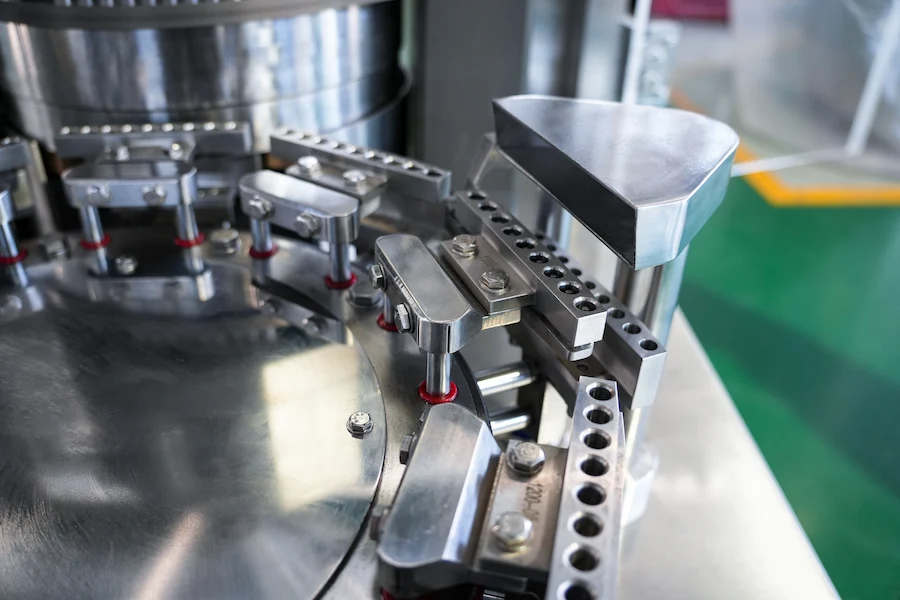
A rejection function may remove capsules identified as defective under its configured criteria. It should not be assumed to provide individual mass measurement or automatic content-uniformity verification. Confirm whether the specific equipment configuration includes the inspection and weight-checking functions your process requires.
Equipment Selection and Representative Filling Trials
For a new line, define the material and process requirements before selecting a filler. GRAND offers automatic capsule filling machines, including NJP-series equipment. The available dosing systems, format parts and inspection functions depend on the selected model and configuration.
To evaluate the suitability of a proposed configuration, provide the shell size and material, representative powder properties, target net fill weight, required production output and your product’s approved quality requirements. Request a trial protocol that specifies sampling and measurement methods, operating conditions, and how the results will be reported. For the broader procurement process, see our automatic capsule filler selection guide.
A useful acceptance test should report individual net weights and their summary statistics under agreed trial conditions, not merely a claimed accuracy percentage. Results are specific to the formulation, equipment and conditions used.
Questions fréquemment posées
What causes capsule filling weight variation?
Possible contributors include inconsistent powder feed, changes in blend density or cohesion, dosing-component wear or setup, incomplete transfer and measurement error. The observed weight pattern and production records help identify which factor to investigate first.
How do I calculate capsule fill weight?
Subtract the measured empty shell mass from the measured filled capsule mass using the approved weighing procedure. For instance, 620 mg minus 120 mg equals 500 mg net fill. This is the whole formulation, not the active ingredient mass.
What does RSD tell you about capsule filling?
Relative standard deviation expresses the spread of the sample relative to its mean. A low RSD does not prove that the mean is close to target or that individual active ingredient contents are uniform.
Is ±5% a universal acceptable capsule weight variation?
No. Use the applicable approved product specification and relevant compendial requirements. Routine manufacturing weight checks and pharmacopoeial uniformity-of-dosage-units testing have different purposes and methods.
Can changing tamping pin position solve weight variation?
It may affect filling in a tamping-type machine, but the result depends on the powder, dosing components and machine configuration. Any change must be made by trained personnel following the approved procedure and verified with a representative trial.
Does an automatic capsule filler guarantee content uniformity?
No. Automated dosing can support mass consistency, but active ingredient uniformity also depends on blend homogeneity and the applicable analytical tests. Equipment performance must be confirmed for the intended formulation.
Conclusion
Reducing capsule filling weight variation starts with identifying whether the problem is measurement bias, a shift in the average, or inconsistent individual fills. Reliable diagnosis links powder characteristics, dosing conditions, machine configuration and production records to measured results. Confirm any proposed solution through representative trials and the approved quality procedure.
Explore GRAND capsule filling machine solutions and discuss your material, fill-weight target and production requirements with our team.
Références
- Osorio JG, Muzzio FJ. Effects of powder flow properties on capsule filling weight uniformity. Drug Development and Industrial Pharmacy. 2013;39(9):1464–1475.
- Nair R, Vemuri M, Agrawala P, Kim S. Investigation of various factors affecting encapsulation on the In-Cap automatic capsule-filling machine. AAPS PharmSciTech. 2004;5(4):e57. DOI: 10.1208/pt050457.
- US Code of Federal Regulations. 21 CFR 211.110, Sampling and testing of in-process materials and drug products.
- United States Pharmacopeia. General Chapter <905> Uniformity of Dosage Units, Stage 4 Harmonization. Official August 1, 2023.