Powder Mixer Wizardry: Grand Solutions for Pharma Blends
Capsule Filling Machine Q&A: Grand NJP-1200 for Tablet & Pellet Filling
About Grand’s Capsule Filling Machines
Grand pack (Guangzhou Grand Packing) has been a leading manufacturer of capsule filling equipment for over 18 years. Our NJP Series machines cover the full range from semi-automatic to fully automatic capsule fillers. These professional capsule-filling machines can handle hard gelatin capsules, HPMC vegetarian capsules, and even liquid-filled capsules.
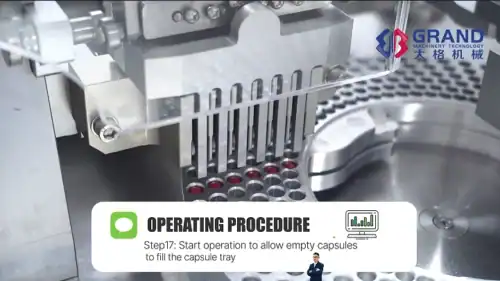
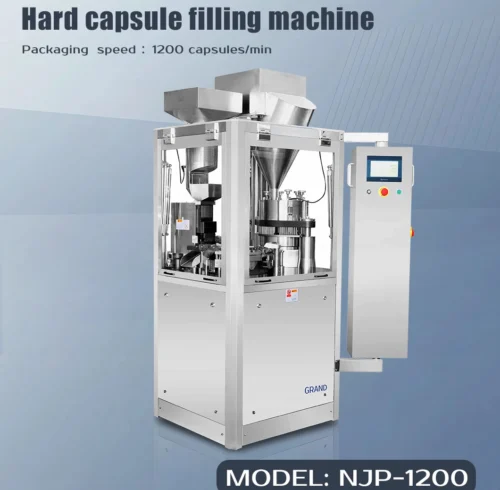
The NJP machines are designed with high-quality stainless steel frames and optimized structures for durability and ease of cleaning. For example, an NJP-1200 in operation (pictured above) will fill, separate, and lock capsules automatically, delivering rapid output while maintaining strict precision. Grand’s technology is engineered to meet pharmaceutical GMP standards, and our machines are trusted by clients worldwide (domestic and international).
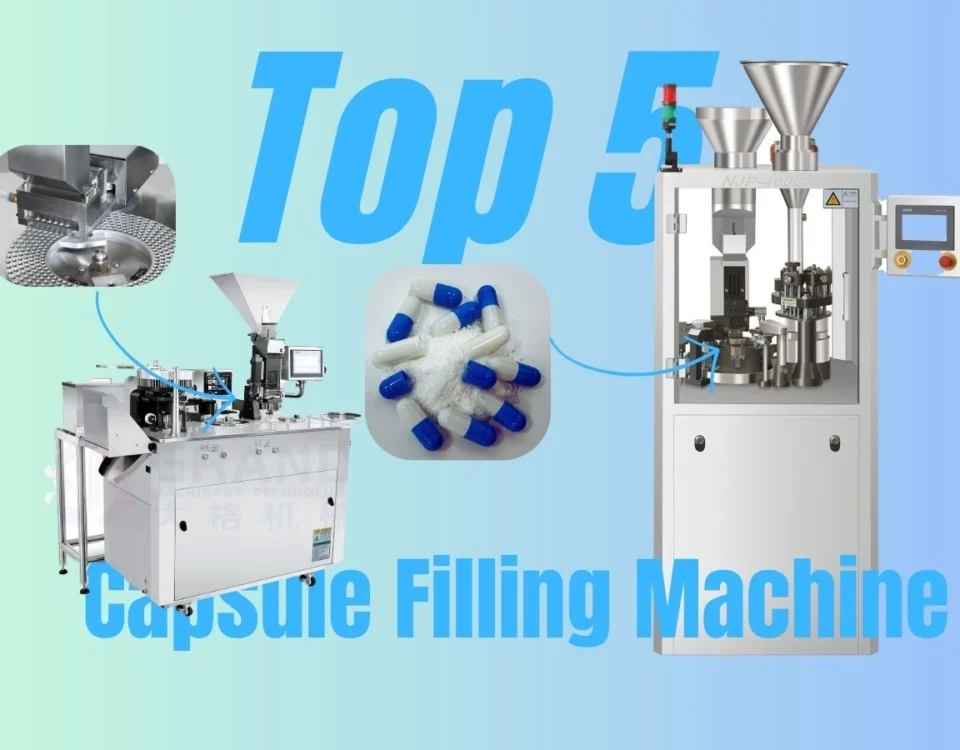
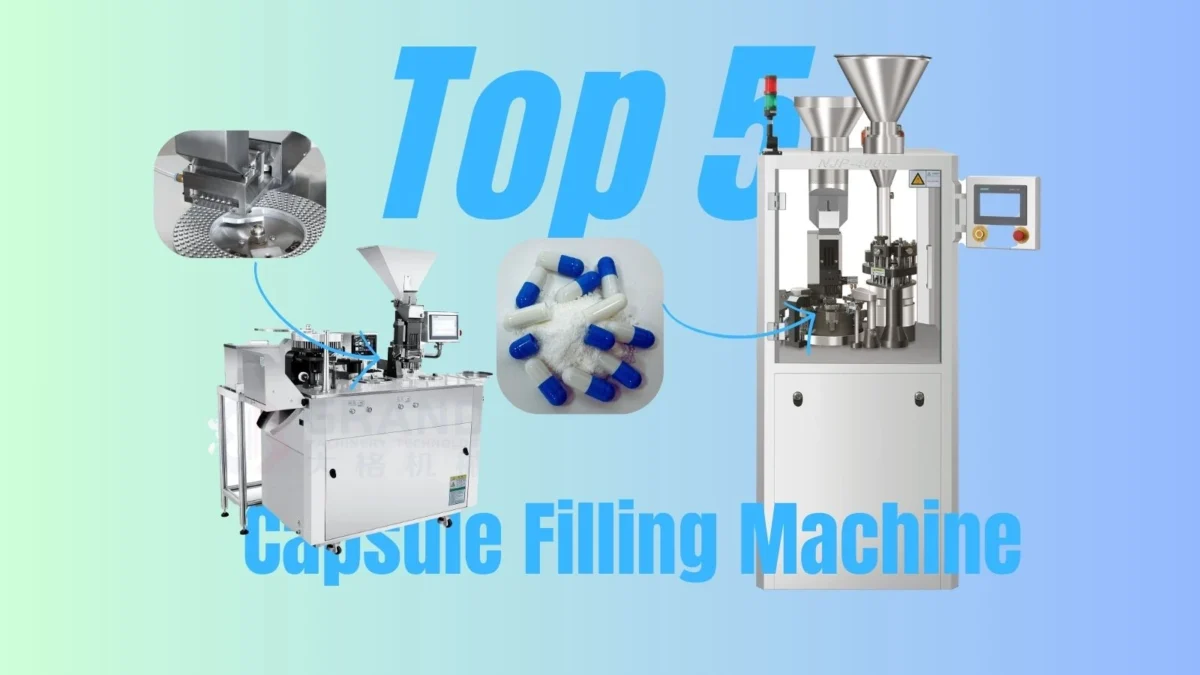
Grand offers both fully automatic capsule filling machines (e.g. the NJP-400, 800, 1200, 2500, etc.) and semi-automatic/manual fillers for smaller-scale or R&D use. All core models (NJP-400, 800, 1200, 2000, etc.) support either powder, pellets, mini-tablets or even liquid dosing.
We also have dedicated liquid-filling machines (like the NJP-260) with high-precision pumps for oils or suspensions.
In every case, Grand’s capsule fillers are built for precision: they routinely achieve fill accuracy on the order of ±3–5%, with advanced dosing systems and sensors to minimize variation.
Models and Capacities
Grand’s NJP series spans a wide range of capacities and capsule sizes. The compact NJP-400 is an entry-level fully automatic capsule filling machine delivering about 24,000 capsules per hour. The NJP-800 raises throughput to ~48,000 cph, while the NJP-1200 (our flagship for many customers) reaches 72,000 capsules/hour.
For very large production, the new NJP-2500C can run up to 150,000 capsules/hour. (Even higher models like NJP-3500C do ~210,000 cph). Despite these high speeds, all machines maintain consistent precision and are CE/GMP certified.
- Capsule Sizes:Grand machines are extremely flexible. With simple change parts, NJP models accept capsule sizes from 000 down to 5 (lengths #000,00,0,1,2,3,4,5). They can also handle long/safety capsules A–E and extended-length capsules. For example, the NJP-1200 and NJP-2500C both support 00# through 5#, covering the full standard range. (The smaller NJP-400 goes 000–4#.) This means one machine can run multiple product lines by swapping out a few size-change parts.
- Power and Footprint:Though high-output, NJP machines have a relatively small footprint and low energy use. Our units use standard 380V (or 220V) 50Hz power and range from ~4–8 kW motors, keeping power consumption modest even at high speed. Robust features like vacuum extraction and dust collection (up to ~210 m³/h extraction) ensure clean, hygienic operation. Noise levels are kept under 75–80 dB, so they fit well in controlled production environments.
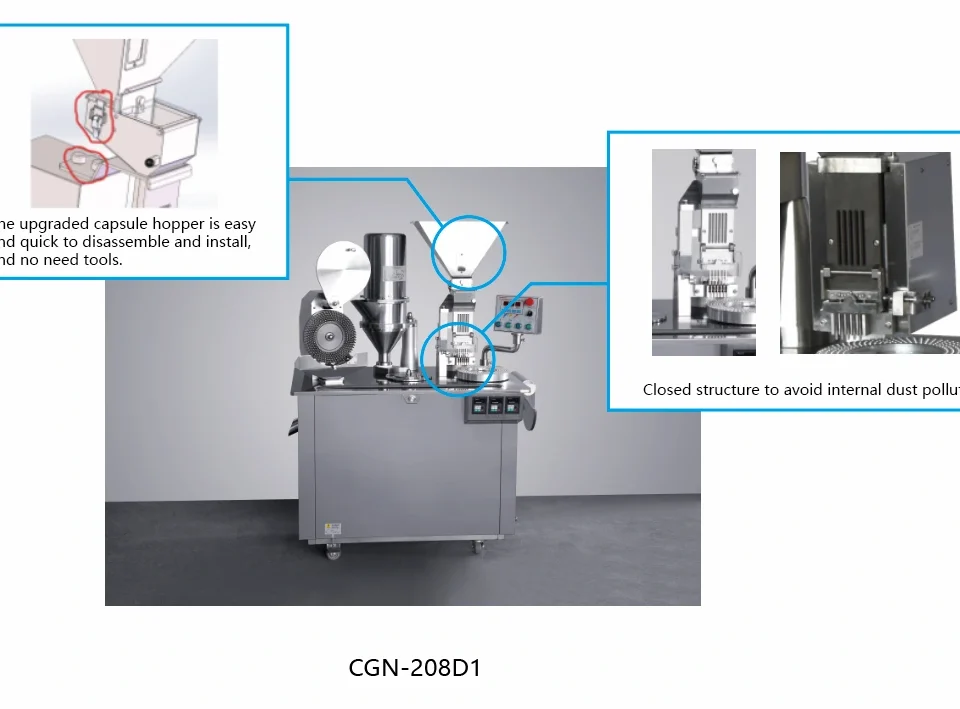
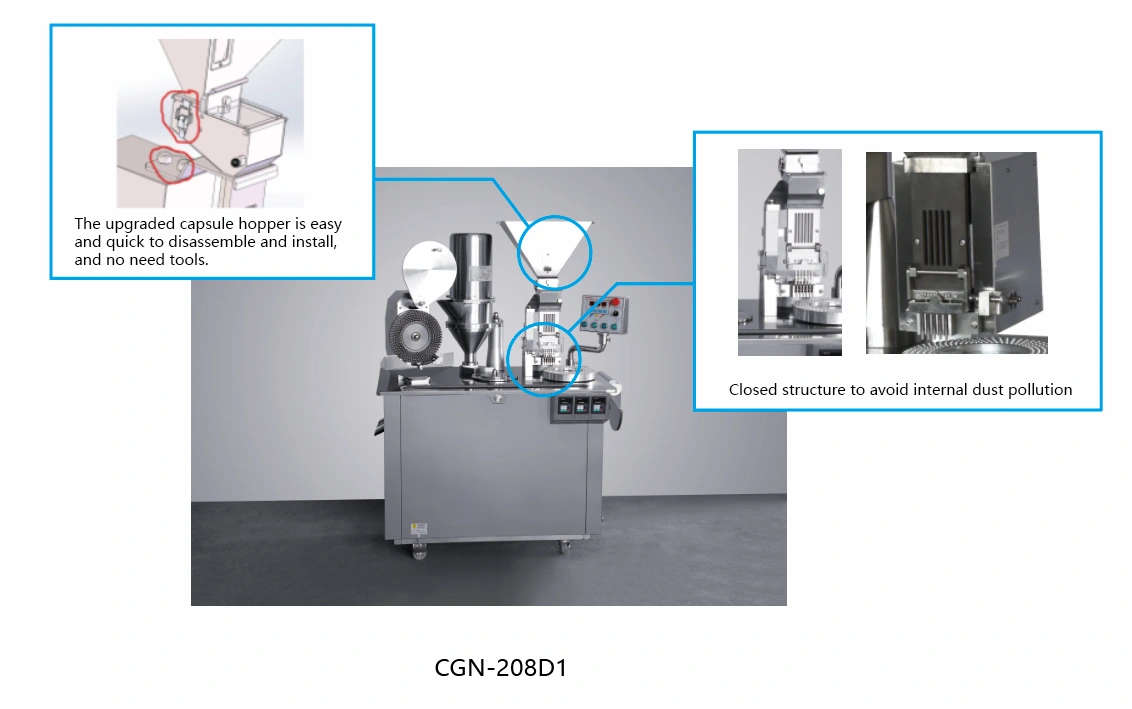
- Semi-Automatic and Manual Options:In addition to fully automatic models, Grand supplies semi-automatic capsule fillers and even hand-operated capsule filler plates. These are ideal for laboratory, small-batch, or test runs. Semi-automatic machines handle up to ~5,000 capsules/hour and still offer the same precision features (with less automation). For example, our CGN-208 series semi-automatic fillers can dose both powder and pellets and are popular for pilot production.
Sequential Tablet & Pellet Filling (Hybrid Dosing)

Q1: Can one machine sequentially fill a tablet and then pellets into the same capsule?
 Answer: Yes, Grand’s NJP machines can be customized for hybrid/combination filling. By adding an extra feeding station and modifying the dosing plates, an NJP-1200 (or similar model) can first drop a tablet (or mini-tablet) into the capsule body, then fill the remainder with pellets (or vice versa). This “mixed-material” capability is a specialty of hybrid capsule fillers, which are designed to handle two different components in sequence.
Not all tablet shapes/sizes are possible, however. Our sales manager advises customers to provide detailed tablet photos and dimensions before customizing the machine. Very thick or irregular tablets may not fit the feed hopper or dosing system. But for typical pharma tablets, Grand can engineer the feeders and discs to accommodate them. We perform extensive testing – feeding, separating, filling, and locking – to ensure the capsule is properly assembled with both components. In practice, the NJP-1200 has extra space to install both a tablet feeder and a pellet feeder. (The larger NJP-2500C can do pellet+powder too, but its spacing makes adding a tablet feeder more challenging.)
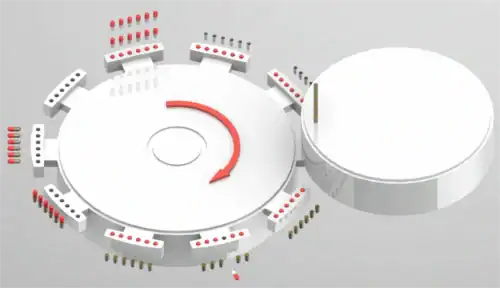
How It Works: The hybrid filling process uses two metering stations. First, an optical or mechanical sensor indexes a capsule body to the tablet-dosing station, where a dosator or insertion arm places one tablet into each capsule.
The capsule then rotates to the pellet-dosing station, which fills the remaining volume using a volumetric cup system (see below).
Finally, the capsule is closed as usual. Advanced machines coordinate these steps automatically, with interlocks to ensure capsules aren’t underfilled. The result is a single capsule containing a tablet plus pellets, which is useful for combination therapies or time-release formulations.
Capsule Size Compatibility
Q2: Which capsule sizes can be handled with change parts?
Answer:Grand confirms that our NJP series covers the full standard size range. The NJP-1200 and similar models can run sizes #000 down to #5 (with the appropriate molds and hoppers).
In fact, any model above 400 can handle 00#–5#; only very small machines like NJP-200 skip 000. As our sales manager noted, sizes #2, #1, and #0 are all readily supported with change parts for NJP machines.
We also have adapters for safety capsule types A–E and extra-long capsules. (Safety capsules have a mini locking ring, and Grand’s NJP design includes tooling to process those.)
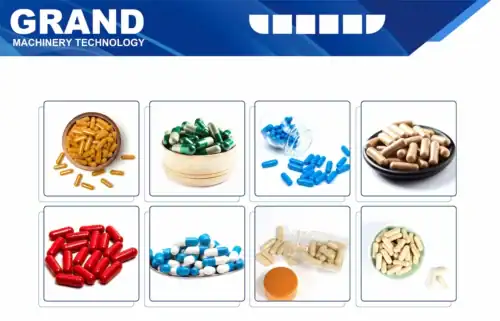
In practical terms, a single NJP-1200 can be quickly reconfigured between sizes by swapping out just a few components: the capsule molds, dosing disc and main hopper, and length-adjustment plates.
The standardized component design means changeover takes only 10–20 minutes and does not compromise the machine’s alignment or accuracy. Customers often run multiple products on one NJP machine, changing sizes as needed. Grand also keeps a range of spare molds and parts in stock, so customers can order kits (e.g. sizes 2, 1, 0) to suit their needs.
Production Capacity & Batch Sizes
Q3: We need to run about 100,000+ capsules per batch. Which model is suitable?
Answer: Our recommendation depends on speed and flexibility. For strictly speed, the NJP-2500C would easily exceed 100,000 capsules/hour (it is rated 150,000 cph).
However, because the customer also wants tablet+pellet filling, our sales team pointed out that only the NJP-1200 currently has the mechanical space to accommodate dual feeding devices. The NJP-1200 runs at about 72,000 capsules per hour. This means a 100,000-capsule run would take under 1.5 hours on the NJP-1200 – still quite efficient for a pilot or small production.
In summary, for mixed filling we recommend NJP-1200 (72k cph); it is one of Grand’s top sellers for large-scale powder/pellet production with flexible feeding. For pure powder/granule filling without tablets, an NJP-2500C or NJP-3500C would be better for 100k+ volumes. We also offer continuous operation (multiple shifts) and turnkey lines.
For example, pairing an NJP-1200 with upstream and downstream equipment (capsule sorter, capsule counter, etc.) can help meet large batch demands.
For very small batches (tens of thousands or less), our semi-automatic machines (e.g. NJP-600) or manual fillers can be more cost-effective. But for any production above ~10,000 capsules per day, we generally recommend fully automatic models for efficiency and consistency.
Filling Accuracy and Dosing Methods
Q4(1): What is the filling accuracy for tablet+pellet filling?
Answer:Grand’s machines are designed for high precision. In general, capsule fillers maintain fill weight tolerances of about ±3–5%. For example, the NJP-1200’s data sheet specifies a filling error of roughly ±3.5–4.5%.
This means each capsule’s contents will be very close to the target weight, minimizing over/under-fills. (Regulatory guidelines also require checking uniformity; Grand machines are capable of meeting strict pharmacopeia standards.)
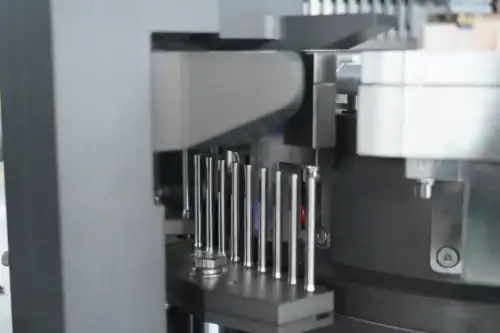
In the hybrid case (tablet + pellet), the overall accuracy depends on each component. The pellet portion typically achieves ~3–4% accuracy – consistent with industry benchmarks. (Pellets can be leveled in the cup feeder to minimize variation.)
We emphasize to customers that accuracy also depends on material properties: very fluffy or irregular pellets may vary more. Nonetheless, our vacuum and tamping systems ensure that almost all capsules are filled correctly. Empty capsule yield and double-capsule rejection rates are both above 99.8%, meaning nearly every capsule is properly processed.
Q4(2): How are pellets fed – auger, vacuum, etc.?
Answer:The NJP series uses a volumetric cup (measuring cup) system for pellet/granule feeding. Pellets flow into a segmented dosing tray, and each capsule hole receives a metered amount based on cup height and vibration. A vacuum extraction under each hole then removes any air and levels the pellet dose, ensuring uniform fill. (This is different from an auger – there is no rotating screw; instead, the segmented feeder plate and vacuum work together for precision.)
For powders, a similar segmented disc dosing method is used. In either case, the machine’s design – including a three-dimensional adjustable dosing tray – allows fine-tuning of fill volume.
If additional accuracy is needed, some customers install a tablet counting/detecting sensor at the tablet feed station to ensure exactly one tablet is dropped per capsule. The machine will alarm and stop if any capsule misses a tablet. Similarly, the pellet hopper uses level sensors so the machine pauses if material runs out. All these control features contribute to consistent dosing and safety.
Q4(3): What is the machine capacity and minimum batch?
Answer:As noted, the NJP-1200 runs about 72,000 caps/hr, and the NJP-2500C about 150,000/hr. There is no real “minimum” batch size other than the practical volumes you wish to produce.
In practice, users often run capsules in the hundreds or thousands for trials. The machine can count output in real time (via PLC) and can stop automatically when a set count is reached. Thus, even small batches are easily handled. For example, filling 100,000 capsules would take 1–2 hours on the NJP-1200; filling 10,000 would take only a few minutes of run time.
Liquid and Semi-Automatic Capsule Filling
In addition to powder/pellet machines, Grand offers specialized liquid capsule filling machines. For example, the NJP-260 is a fully-automatic liquid dosing machine that uses a servo pump and closed rotary die-wheel for high-precision liquid fills. It can fill oils, suspensions or gels into hard capsules at ±3% accuracy by weight. (This is essential for products like liquid vitamins or nutraceuticals.) We also provide semi-automatic liquid fillers and integrated liquid capsule lines, depending on customer needs.
On the semi-automatic side, Grand’s CGN and CCN series machines offer bench-top or stand-alone filling for powders, pellets or liquids at 200–6,000 capsules/hour.
These are ideal for R&D labs or pilot plants. All our machines (manual, semi, or full-automatic) are built to the same quality standards and can be upgraded with automation modules over time. And importantly, Grand provides lifetime after-sales support – our engineers help with installation, training, maintenance, and spare parts whenever needed.
Design Innovations and Materials
Grand’s capsule fillers incorporate many design optimizations to improve durability and precision. Key features include:
- High-Quality Materials:All product-contact parts are SUS304 stainless steel (or higher grade) to meet GMP/CFR standards. Bearings, shafts and cams use imported components for long life. The frames are welded, stress-relieved, and powder-coated for stability.
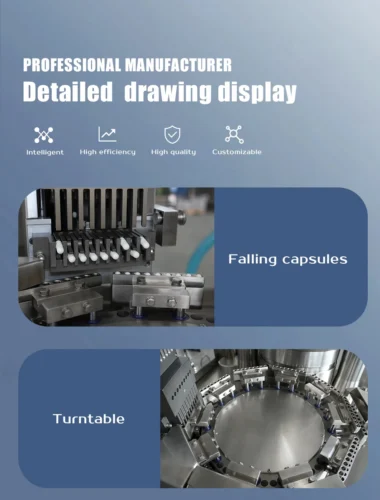
- Optimized Mechanics:We have refined the inner turntable design (using Japanese linear bearings) to enhance indexing accuracy and reduce wear. The cam system is mounted beneath the main body with a pressure-lubrication oil pump, which keeps the cam grooves oiled and extends the intervals between maintenance. The dosing tray is aligned using a three-dimensional adjuster, ensuring the gap between the tray and the die plate is uniform – this gives very even fill weights across all capsules. All moving parts have easily accessible covers or guards for cleaning.
- Vacuum and Safety Systems:Each filling station on an NJP machine has a dedicated vacuum extraction to level the fill and remove dust. The vacuum-holding structure (cup or die) achieves over 99.9% capsule picking accuracy, greatly reducing mis-feeds. For example, the NJP-400’s vacuum system is rated at 30 m³/h, ensuring strong capsule clamping during fill. Sensors monitor capsule presence, pellet hopper level, capsule cap presence, etc., automatically pausing the machine if any anomaly is detected.
- User Interface & Maintenance:All machines use a modern HMI touchscreen for parameter setting and real-time monitoring. Recipe memory allows quick recall of each product’s settings. Routine cleaning is simplified – many contact parts (pallet, caps separator, etc.) are hinged or removable. The hopper and dosing cups can be quickly disassembled without tools, addressing concerns like Chinese herbal residues (as on our new “vibrating butterfly valve” hopper design). A nightly cleaning cycle or CIP (clean-in-place) can be run if needed.
These structural optimizations not only improve accuracy, but also reduce noise and power consumption. In fact, Grand’s own testing shows <75 dB sound levels and <6 kW power usage at full speed for an NJP-1200. Our customers often comment on how “robust” the machines feel – solidly built yet user-friendly. This trust comes from our 18+ years of continuous improvement and customer feedback.
Why Choose Grand – Asia’s Competitive Edge
Grand’s capsule filling machines have a strong reputation in Asia and worldwide. As one of China’s earliest capsule machine manufacturers, we have over 18 years of experience developing this technology. We intimately understand Asian pharmaceutical needs – for example, designing hoppers and feeders that handle common Asian herbal granules and powders. Indeed, the NJP series was optimized specifically with “features of traditional Chinese medicine (TCM)” in mind, while still complying fully with international GMP.
Because we are locally based (Hunan and Wenzhou operations), Grand offers very competitive pricing compared to Western brands, without compromising quality. We source materials efficiently at scale, and we can rapidly tailor solutions for the Asian market. At the same time, all our machines carry CE, ISO and GMP certifications, and we regularly export to Europe, North America, and the Middle East. The Asia advantage is our ability to provide both high-tech innovation and responsive service. We offer factory visits, virtual demos, and fast shipping (as shown by our “in-stock” machines ready for export).
For after-sales, Grand’s global support network means you can get training and spare parts quickly. Our website and engineers provide troubleshooting guides, and we even allow customers to visually confirm their finished capsules before dispatch with full documentation. As one testimonial notes, “Clients choose Grand not only for our reliable products and flexible configurations, but also for our ‘in-stock supply + fast shipping’ capability… Grand Packing is more than a machine manufacturer; we are a dependable supply chain partner”.
Advanced Capsule Filling Precision
Capsule uniformity and dosage precision are critical in pharma manufacturing. Grand’s machines attain industry-leading precision (typically ±3–5% of target fill weight). This tight tolerance ensures that each capsule’s dose meets regulatory standards. Our dosing systems (vacuum, tamping, and filtration) and material control (stable feed hoppers and vibration) minimize yield loss – usually under 3% waste. Automated weight-check sensors can even be added for in-line quality control, adjusting fills in real time.
In practice, this means less raw material waste and more consistent batches. For customers filling high-potency or expensive APIs, that precision translates to big cost savings. For example, many active ingredients used in health supplements require exact dosing. With Grand’s NJP machines, manufacturers confidently achieve uniform capsules (like the pink-and-white capsules shown above) batch after batch.
Conclusion
Grand’s NJP capsule filling machines blend high speed, flexibility, and precision. Whether you need to fill pure powders, conduct dual dosing with tablets and pellets, or even handle liquids, Grand has a solution. In this Q&A, our sales manager addressed common concerns: sequential filling capability, size ranges, batch scalability, accuracy, and machine options. The answers highlight Grand’s strengths: customizability, robust design, and Asia-based advantages.
Choosing a Grand machine means partnering with a seasoned manufacturer. We ensure full documentation, global support, and training. Our ongoing innovations (advanced dosing cams, HMI controls, quick-change parts) keep the NJP line at the forefront of the capsule-filling industry. For more information or to see a machine in action, please contact Grand Packaging. Our sales team (led by experts like Ikol Cai) is ready to answer all your questions and tailor a capsule filling solution to your needs.
Key Takeaways: Grand’s fully automatic capsule filling machines (capsule filler) offer high throughput (tens of thousands of capsules per hour), broad size compatibility (000–5#), and precise filling performance (around ±3%). We provide end-to-end solutions (powder, pellet, tablet or liquid filling) with customizable configurations. With optimized structure and materials, and nearly two decades of experience, Grand is a leading partner for any pharmaceutical or nutraceutical manufacturer looking to automate capsule production.
Develop Your Business with Grand