Mastering Ointment Tube Filling & Sealing with the NF-150

Grand GZPK-26 Rotary Tablet Press: High-Speed Smart Production
Zero Defects in Extreme Environments | GRAND Capsule Fillers & Visual Inspection Systems
On a crisp December night under the dark skies of rural Conghua, I watched the Geminid meteor shower blaze across the heavens, each streak lasting only a fraction of a second. Capturing these fleeting meteors with my camera demanded split-second timing, a fast wide-angle lens (f/2.8 or faster), and an intervalometer to keep shooting continuously.
Meteor photography therefore mirrors the high-speed precision needed in pharmaceutical machinery. Just as I set my camera for rapid exposures (10–30 second shutter speeds, high ISO) to catch each brief fireball, modern capsule-filling machines rely on fast PLC and servo-driven controls to fill thousands of capsules per minute with exact doses.
For example, advanced automatic capsule fillers can run at 50,000–150,000 capsules per hour, leveraging real-time PLC feedback and servo motors for constant accuracy. In both cases, a tiny lapse in timing could mean missing the shot or underfilling a batch – precision timing and speed are everything.

Three single images of the Geminid meteor shower were combined to create this composite image – photographed in Conghua, China. Grand Company also conducts extensive research into mechanical precision and durability, providing customers with breathtaking "works of art."
High-Speed Photography Meets High-Speed Filling
Meteor photography requires not only fast lenses but also stable, automated capture. A sturdy tripod and intervalometer let you take dozens of 20–30 second exposures back-to-back without shake. In capsule manufacturing, comparable automation keeps production steady. The latest GRAND capsule filling machines use PLCs and brushless servo motors to coordinate dosing, capsule feeding, and ejection in a precisely-timed cycle. One high-speed machine – the NJT-2500 – can fill up to 200,000 capsules per hour and integrates PLC controls for quality checks. Like programming a camera’s intervalometer, engineers program PLC sequences to ensure each capsule is processed at exactly the right moment.
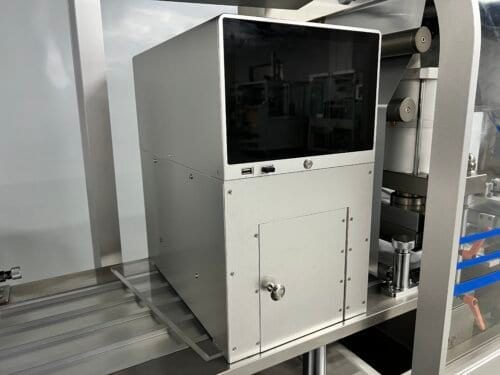
Grandpackmachine's blister packaging machines can be equipped with an optional vision inspection system to help detect capsule packaging defects.
- Fast lens vs. fast drives:A meteor shooter uses an aperture as wide as possible (e.g. f/2.8) and a high ISO to capture faint trails. Likewise, capsule fillers use high-speed servo drives to rapidly move pistons or turrets. Modern fillers achieve dose precision better than ±0.3 mg even at tens of thousands per hour.
- Continuous capture vs. continuous production:Just as I trigger my camera repeatedly all night (often hundreds of exposures), industrial lines run 24/7. Both applications require systems that can run long-duration processes without missing a beat or overheating.
High-Resolution Imaging
The goal of both astrophotography and pharmaceutical inspection is to catch small details in a fast-moving environment. In meteoric timelapses, each image must preserve sharp star fields and any meteor streaks against the dark sky. In pharma, high-resolution cameras inspect each capsule for defects. For instance, GRAND’s automated visual inspection systems use AI-powered cameras to scan 360° of each capsule’s surface at high speed. One industry example is the Viswill T/CVIS-NSR system, which inspects up to 125,000 capsules per hour. The capsules ride on vacuum-fed belts so that cameras can capture every angle in real time. This is akin to stacking many high-resolution frames in astrophotography to reveal faint details – only here the camera is looking for cracks, spots or color variations instead of star constellations.

GV-1300 Bottle Cap Packaging Auto Inspection Machine
Bullet points of similarity:
- Both fields demand high resolution imaging. Astrophotographers use 20–50 MP full-frame sensors to record distant galaxies and bright meteor trails. Pharma vision systems use megapixel industrial cameras (often with bright ring lights) to detect even pinhead-sized defects on capsules or tablets at production speed.
- Real-time analysis: While I watch my camera monitor for meteors, automated vision systems instantly analyze each image. For example, 100% of capsules are quickly checked against quality criteria, and defects are rejected on the spot – much like an astrophotography program automatically flags and saves only frames with meteors.
Analogies of Transience and Scale
Meteors are literally transient: streaks that appear and vanish in milliseconds. Capturing them at scale (tens of meteors in a single frame set) is like ensuring a manufacturing line never misses a defective capsule among millions. Both endeavors seek “zero miss” outcomes. Astrophotographers leave cameras shooting for hours to collect rare bright fireballs; pharma lines fill millions of units while aiming for zero defects. The comparison highlights the shared goal: capture every fleeting detail, whether celestial or capsule.

In sum, the high-speed precision of meteor photography resonates deeply with the engineering of pharmaceutical machinery. Timing electronics and quick actuators in a camera find their parallel in PLC logic and servo drives on a capsule filler. High-resolution night sky images mirror the detailed visuals needed for 100% inspection. Every technical challenge of photographing the Geminids – timing, stability, sensitivity – has a counterpart in Grandpack’s equipment design. By chasing shooting stars in Conghua, we are reminded how Grandpack’s machines chase perfection on the factory floor: both demand the utmost in precision, speed, and innovation.
Battling Light, Cold, and Contamination
Photographers must contend with dew, freezing air, and stray lights. We use dew heaters and lens hoods to prevent condensation, and backup batteries because cold drains power. Similarly, pharma cleanrooms use special engineering to control dust, temperature, and humidity. For example, GMP guidelines dictate precise cleanroom classes and stable climate: temperature is held around 10–25 °C and relative humidity 35–45 % to prevent microbial growth and ensure product stability. These controlled environments are akin to a photographer dressing in warm layers and sealing their camera in a dry-bag – it all protects the process.

In practice, Grandpack’s capsule filling and inspection machines are designed for these extreme conditions. Machines have stainless steel frames and GMP construction so they can be thoroughly cleaned and won’t harbor contaminants. Many units support in-place cleaning (CIP) and even sterilization (SIP). As one engineering reference notes, CIP systems “enable internal surfaces to be cleaned with minimal disassembly,” while SIP (often using 121 °C steam) sterilizes equipment without autoclaving. This is like keeping a telescope lens clear with a heater: the machine’s self-contained cleaning cycle keeps the environment sterile.
- Remote and Automated Cleaning:Just as we set up cameras on remote intervals, pharma systems are automated for long runs. CIP/SIP routines are preprogrammed – no technician needs to dismantle the line between batches. This cuts downtime and ensures consistent hygiene standards.
- Validated Performance:After assembling equipment in the plant, engineers perform IQ/OQ/PQ qualification (Installation, Operational, Performance Qualification). This rigorous testing underpins confidence that the machines will run flawlessly under real production stress, just as a carefully balanced tripod promises stable long exposures.
24/7 Reliability: Night Watches and Production Runs
Our meteor shoot lasted all night. The camera had to stay focused and powered from dusk till dawn. Likewise, pharmaceutical lines often operate continuously. Equipment is built for round-the-clock reliability: stainless steel, clean-in-place design, and self-monitoring features help avoid breakdowns. Modern machines often include real-time diagnostics (vibrations, temperature, motor load) to catch issues early. Think of it as a photographer monitoring exposure histograms: any anomaly triggers an alert.
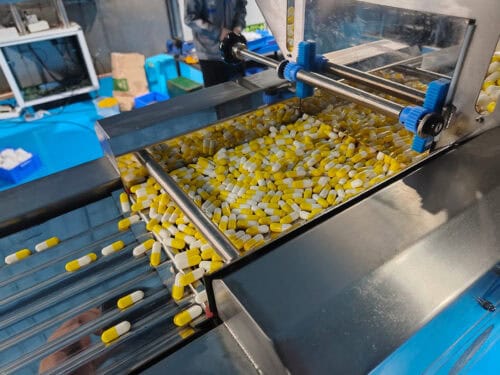
In an analogous way, Grandpack values rigorous validation. IQ/OQ/PQ protocols guarantee that once installed, the capsule fillers and inspection systems truly meet specifications. For instance, IQ checks that each piece of hardware and software is correctly set up; OQ tests individual components under operating conditions; and PQ confirms the whole process produces consistent, compliant results. This procedure is as meticulous as calibrating a telescope mount before a night of star-gazing – it ensures no surprises once production starts.
Zero Defects, Zero Compromise
Just as a perfect meteor photograph needs a completely dark sky, zero-defect pharmaceutical output needs a pristine process. Even a tiny speck on a capsule could be a critical flaw, like a stray car’s headlights spoiling a night shot. Grandpack’s visual inspection systems serve as vigilant guards: using AI-driven optics, they catch microscopic errors in real time. For example, the T/CVIS-NSR inspection machine detects every capsule at up to 125,000 per hour, and its sorting mechanism “ensures that any defective product is fail-safely rejected”. This is akin to stacking astrophotos to isolate every shooting star – no detail gets past the system.
Even under “stormy” conditions – be it blizzards in Conghua or messy production – these machines uphold quality. They are engineered with resilience: covered electronics, vibration dampers, and tight seals prevent external factors from causing errors. In practice, their performance in harsh environments has to be verified. Cleanroom compatibility is documented (cGMP compliance) and maintenance schedules (including CIP/SIP cycles) are logged, much like an astro-timelapse logging equipment status throughout the night.
Finally, both experiences reinforce that precision and reliability are non-negotiable. At the close of our meteor-watching session, I packed up a record of hundreds of exposures, each frame saved precisely when meteors appeared. In the plant, Grandpack’s capsule lines pack records of millions of doses, each capsule checked and documented. Both are guided by the same goal: innovation that doesn’t compromise on quality.
Conclusion: The silent, starry sweep of the Geminids reminds us how fleeting perfection can be – and how engineering can capture it. Whether through the lens of a DSLR or the logic of a PLC, the hunt for zero defects drives us to the same place: a commitment to excellence. Grandpack’s machines embody this ethos. Like a determined night sky photographer, Grandpack stands vigil in extreme conditions, ensuring every capsule filled and every cosmetic jar sealed meets the highest standards. Precision, cleanliness, and innovation – these are the stars that guide Grandpack’s journey as surely as they guide our eyes upward on a dark December night.
Develop Your Business with Grand