
Pharmaceutical Blister Packaging Defects: Causes, Inspection & Prevention
Blister Tooling Design for a New Tablet Shape or Blister Card Layout
Start a blister tooling design review with the current and proposed pack drawings, a representative product sample and the machine model. A change from ten to fourteen tablets per card can affect the pocket layout even when the tablet stays the same. A switch from a round to an oblong tablet can also change how the product reaches the pocket. Compare the drawings at the forming, feeding, sealing and cutting stations. Record which parts the supplier proposes to retain, which measurements support that choice and what the first trial packs must demonstrate.
The worked examples below illustrate the engineering review method. Actual tooling limits, material-specific seal requirements and trial acceptance criteria must be confirmed against the installed machine and the packaging site’s approved documents.
Apply Blister Pack Design Guidelines to the Current and Proposed Drawings
Tool reuse is a drawing-to-machine decision, not just a tablet-fit question. Compare the released drawing with the proposed drawing revision, both showing web direction. Identify the machine model, serial number, installed options and format-part IDs.
Measure representative tablets across L × W × T tolerances and edge profiles. Attach forming web and lidding specifications: laminate, thickness, grade and width. Material changes can alter forming and sealing even when geometry is fixed.
Table 1. Current and Proposed Blister Format Dimensions
| Drawing input | Current 10-count format | Proposed 14-count format | Engineering check |
|---|---|---|---|
| Tablets per card | 10 | 14 | Match saleable count, artwork and carton. |
| Pocket grid / web direction | 2 across × 5 along | 2 across × 7 along | Confirm drawing orientation. |
| Tablet L × W × T (mm) | Measure samples and tolerance range. | Confirm unchanged product specification. | Check worst-case envelope. |
| Cavity footprint, depth, pitch (mm) | Read forming-die drawing. | Dimension proposed pocket pitch (mm). | Check product fit and inter-pocket land. |
| Card L × W; seal land (mm) | Read cut and seal drawings. | Compare fixed and enlarged outlines. | Measure sealing land width (mm) at cavities, edges and perforations. |
| Web width (mm); laminate | Record reel and lidding grades. | Confirm material and trim. | Check forming width, guides and foil print. |
| Web advance (mm/index); datum | Log installed index and registration datum. | Log index, print repeat and revision. | Check station timing, not card length alone. |
Scroll horizontally to view all columns on a smaller screen.
Mark fields unchanged / changed / unconfirmed. Use one registration datum on cavity, foil, perforation and cut drawings; check carton handling too. Missing values are not evidence of reuse.
The machine determines the usable format envelope. See the блистерная упаковочная машина range for context, then use the installed machine’s limits.
How the Blister Pocket Layout Changes from 10 to 14 Tablets
This hypothetical example holds product and material constant: two rows across web travel, with five then seven pockets along it. Rotating the layout changes the machine constraints.
How does a 10-to-14-count change affect a two-row blister card?
With equal spacing, five pockets create four pitches; seven create six. Let n be the pocket count along web travel, С the card length in that direction, d the outside cavity footprint (not tablet length), e₁/e₂ the end lands and p the center pitch. Required geometry:
(n − 1) × p + d + e₁ + e₂ ≤ C
This is geometry, not a sealing limit. For equal straight-sided pockets, approximate inter-cavity land as p − d; measure the true minimum for curved pockets.
Option A — keep the outline. If С, d and end lands stay fixed, available pitch changes from (C − d − e₁ − e₂) / 4 к (C − d − e₁ − e₂) / 6—two-thirds of the original geometric maximum. This is нет a pitch recommendation. Verify pocket separation, seal continuity and cross-web land—especially for cold-form Alu-Alu laminates, which require wider draw skirts and minimum inter-cavity lands than thermoformed PVC to avoid pinholes or seal delamination.
Option B — retain pitch and enlarge the card. With unchanged cavity and margins, minimum length increases by 2p. Check the forming area, foil repeat, perforations, cut profile and carton envelope. Web index is not necessarily card length; a machine may handle multiple cards per advance.
The two pockets across the web need a separate width check. Include guide rails, edge trim, adjacent lanes and the actual working width of the forming tool; the forming web’s nominal roll width is not all usable cavity area. If seven columns instead lie cross-web, width and lane clearance—not this length formula—become the first constraints.
Overlay forming, sealing and blanking die drawings at one datum. The forming die needs the new array unless a modular tool demonstrably supports it. Verify sealing-plate relief, sealing land and blanking registration. Ask for both dimensioned options.
Review Four Stations Before a Blister Format Changeover
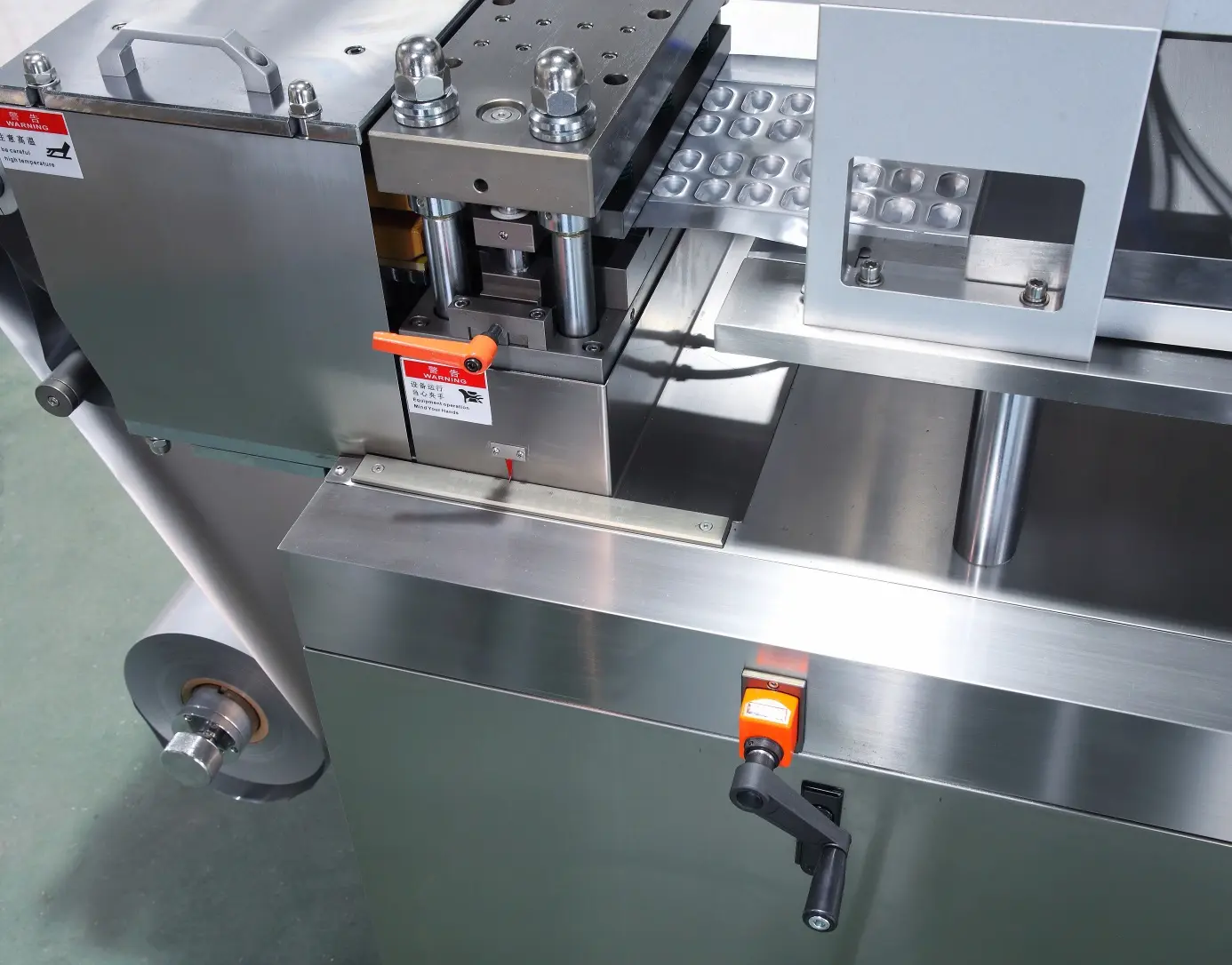
Now keep count and outline fixed while changing round to oblong tablets. The cut may remain usable while the cavity or feeder changes. Compare maximum length, width, thickness and edge profile.
Which stations need review when a round tablet changes to an oblong tablet?
Define the oblong’s long-axis orientation. A large shared cavity can still permit poor feeding or excess headspace. Honeywell’s Aclar tooling guide discusses dedicated cavities and lid clearance; its numerical advice is material-specific, not universal.
Table 2. Tooling Review by Station
| Station / part | Retain, modify or replace when… | Required comparison | First-pack evidence |
|---|---|---|---|
| Формирование: forming die, web | Reuse if both shapes fit and form reliably; replace incompatible cavity. | Cavity L/W, pocket depth (mm), radius, film, lid clearance. | Cavity measurement, wall condition, fit and lot. |
| Кормление: feeder guide, transfer | Reuse if long-axis orientation is consistent; modify for rotation or bridging. | Product tolerances, entry angle, pocket axis. | Occupancy, misfeeds, orientation and damage. |
| Уплотнение: sealing plate or roller | Reuse if pocket relief and continuous land remain valid. | Lidding, relief, seal pattern, registration. | Appearance and agreed integrity-test result. |
| Резка: blanking die, register | Reuse if cut outline and registration match. | Card L × W, corner radius, datum and cut offsets. | Card size, registration and handoff. |
Scroll horizontally to view all columns on a smaller screen.
Check whether the installed sealer uses platen or rotary tooling; parts are not interchangeable. Seal appearance alone does not establish integrity.
See the blister packaging machine buying guide for architecture context. Request reuse / modify / replace / pending test for each part, tied to ID, revision and evidence. Toolrite’s format-parts overview independently illustrates the station dependencies.
For example, an unchanged card contour may justify provisional blanking-die reuse, but not reuse of the round cavity or feeder guide. Conversely, a new cavity may be required while the sealer remains usable if its relief and continuous seal lands still pass inspection. No part should be signed off solely because its mounting dimensions match.
Verify the First Packs Against the Approved Drawing
First packs are an engineering trial, not a production release. Agree on drawing revision, conditions, sample locations and count, inspection methods, acceptance criteria and sign-off до the run. Do not invent universal sample quantities.
From drawing to documented trial evidence
- Approved drawingsRevision, samples, material specifications
- Four stationsForming, feeding, sealing, cutting
- First-pack checksMeasurements, integrity test, observations
- Engineering dispositionApprove, correct and retest, or keep pending
Retain one traceable evidence record:
- Identity: machine/configuration, product lot, drawing revisions, trial date and reviewers.
- Parts/settings: tooling IDs, adjustments, web/foil grade, thickness and lots, web width, index and datum.
- Geometry: pocket depth/pitch, lands, card dimensions, cut offsets, limits and units.
- Операция: cavity-by-cavity fill, oblong orientation, damage and startup/stable-run observations.
- Verification: integrity method and limit, results, sample counts, deviations, corrective retest and disposition.
Для 10 → 14, check every pocket position and both end pockets against the cut datum. For round → oblong, document orientation and seating before sealing. These scenarios challenge different failure mechanisms.
An inspection map should label every sampled pocket and the point in the run when it was taken. Attach photographs or instrument records to the same sample IDs, so a failed seal or offset can be traced to material lot, tooling, setup and corrective action without guessing.
If sealing, filling or registration fails, segregate trial packs, document deviation and retest. The pharmaceutical blister packaging defects guide helps classify symptoms, not set acceptance limits.
Sign off each station’s disposition; mark missing evidence pending. An engineering trial does not replace qualification, validation or site release procedures.
Frequently Asked Questions About Tooling Reuse and First-Pack Checks
Can two tablet shapes share the same forming die?
Reuse is possible when the existing pocket accommodates both products through their dimensional tolerances and allows reliable feeding and sealing. Compare representative samples with the approved pocket drawing. Record the supplier’s fit assessment, then check product orientation, visible damage and pocket clearance on trial packs before approving the shared format.
Does a new card outline always require a new cutting die?
Review the existing cutting profile against the proposed card outline. A change to the outer dimensions or corner radius can affect the blanking tool even when the pockets stay in place. If only the pocket layout changes, verify registration against the existing cut before deciding whether a replacement is needed.
What should the team check on the first packs after a format change?
Compare the first trial packs with the approved drawing and inspection plan. Check cavity shape, product presence and orientation, seal appearance and cut registration. Record the drawing revision, tooling identifiers and material lots. Use the agreed seal integrity test and acceptance criteria before releasing the format for production.
If the installed machine is a DPP-270, use the DPP-270 blister packing machine page to identify the equipment family, then send its exact configuration and revision with the samples and pack drawings; the product page alone cannot confirm format compatibility.
Send your machine model, product dimensions, and current and proposed pack drawings using the form on this page. Our team can review which stations need a new format part and which checks to include in a sample run.
Start a blister tooling design review with the current and proposed pack drawings, a representative product sample and the machine model. A change from ten to fourteen tablets per card can affect the pocket layout even when the tablet stays the same. A switch from a round to an oblong tablet can also change how the product reaches the pocket. Compare the drawings at the forming, feeding, sealing and cutting stations. Record which parts the supplier proposes to retain, which measurements support that choice and what the first trial packs must demonstrate.
The worked examples below illustrate the engineering review method. Actual tooling limits, material-specific seal requirements and trial acceptance criteria must be confirmed against the installed machine and the packaging site’s approved documents.
Apply Blister Pack Design Guidelines to the Current and Proposed Drawings
Tool reuse is a drawing-to-machine decision, not just a tablet-fit question. Compare the released drawing with the proposed drawing revision, both showing web direction. Identify the machine model, serial number, installed options and format-part IDs.
Measure representative tablets across L × W × T tolerances and edge profiles. Attach forming web and lidding specifications: laminate, thickness, grade and width. Material changes can alter forming and sealing even when geometry is fixed.
Table 1. Current and Proposed Blister Format Dimensions
| Drawing input | Current 10-count format | Proposed 14-count format | Engineering check |
|---|---|---|---|
| Tablets per card | 10 | 14 | Match saleable count, artwork and carton. |
| Pocket grid / web direction | 2 across × 5 along | 2 across × 7 along | Confirm drawing orientation. |
| Tablet L × W × T (mm) | Measure samples and tolerance range. | Confirm unchanged product specification. | Check worst-case envelope. |
| Cavity footprint, depth, pitch (mm) | Read forming-die drawing. | Dimension proposed pocket pitch (mm). | Check product fit and inter-pocket land. |
| Card L × W; seal land (mm) | Read cut and seal drawings. | Compare fixed and enlarged outlines. | Measure sealing land width (mm) at cavities, edges and perforations. |
| Web width (mm); laminate | Record reel and lidding grades. | Confirm material and trim. | Check forming width, guides and foil print. |
| Web advance (mm/index); datum | Log installed index and registration datum. | Log index, print repeat and revision. | Check station timing, not card length alone. |
Scroll horizontally to view all columns on a smaller screen.
Mark fields unchanged / changed / unconfirmed. Use one registration datum on cavity, foil, perforation and cut drawings; check carton handling too. Missing values are not evidence of reuse.
The machine determines the usable format envelope. See the блистерная упаковочная машина range for context, then use the installed machine’s limits.
How the Blister Pocket Layout Changes from 10 to 14 Tablets
This hypothetical example holds product and material constant: two rows across web travel, with five then seven pockets along it. Rotating the layout changes the machine constraints.
How does a 10-to-14-count change affect a two-row blister card?
With equal spacing, five pockets create four pitches; seven create six. Let n be the pocket count along web travel, С the card length in that direction, d the outside cavity footprint (not tablet length), e₁/e₂ the end lands and p the center pitch. Required geometry:
(n − 1) × p + d + e₁ + e₂ ≤ C
This is geometry, not a sealing limit. For equal straight-sided pockets, approximate inter-cavity land as p − d; measure the true minimum for curved pockets.
Option A — keep the outline. If С, d and end lands stay fixed, available pitch changes from (C − d − e₁ − e₂) / 4 к (C − d − e₁ − e₂) / 6—two-thirds of the original geometric maximum. This is нет a pitch recommendation. Verify pocket separation, seal continuity and cross-web land—especially for cold-form Alu-Alu laminates, which require wider draw skirts and minimum inter-cavity lands than thermoformed PVC to avoid pinholes or seal delamination.
Option B — retain pitch and enlarge the card. With unchanged cavity and margins, minimum length increases by 2p. Check the forming area, foil repeat, perforations, cut profile and carton envelope. Web index is not necessarily card length; a machine may handle multiple cards per advance.
The two pockets across the web need a separate width check. Include guide rails, edge trim, adjacent lanes and the actual working width of the forming tool; the forming web’s nominal roll width is not all usable cavity area. If seven columns instead lie cross-web, width and lane clearance—not this length formula—become the first constraints.
Overlay forming, sealing and blanking die drawings at one datum. The forming die needs the new array unless a modular tool demonstrably supports it. Verify sealing-plate relief, sealing land and blanking registration. Ask for both dimensioned options.
Review Four Stations Before a Blister Format Changeover
Now keep count and outline fixed while changing round to oblong tablets. The cut may remain usable while the cavity or feeder changes. Compare maximum length, width, thickness and edge profile.
Which stations need review when a round tablet changes to an oblong tablet?
Define the oblong’s long-axis orientation. A large shared cavity can still permit poor feeding or excess headspace. Honeywell’s Aclar tooling guide discusses dedicated cavities and lid clearance; its numerical advice is material-specific, not universal.
Table 2. Tooling Review by Station
| Station / part | Retain, modify or replace when… | Required comparison | First-pack evidence |
|---|---|---|---|
| Формирование: forming die, web | Reuse if both shapes fit and form reliably; replace incompatible cavity. | Cavity L/W, pocket depth (mm), radius, film, lid clearance. | Cavity measurement, wall condition, fit and lot. |
| Кормление: feeder guide, transfer | Reuse if long-axis orientation is consistent; modify for rotation or bridging. | Product tolerances, entry angle, pocket axis. | Occupancy, misfeeds, orientation and damage. |
| Уплотнение: sealing plate or roller | Reuse if pocket relief and continuous land remain valid. | Lidding, relief, seal pattern, registration. | Appearance and agreed integrity-test result. |
| Резка: blanking die, register | Reuse if cut outline and registration match. | Card L × W, corner radius, datum and cut offsets. | Card size, registration and handoff. |
Scroll horizontally to view all columns on a smaller screen.
Check whether the installed sealer uses platen or rotary tooling; parts are not interchangeable. Seal appearance alone does not establish integrity.
See the blister packaging machine buying guide for architecture context. Request reuse / modify / replace / pending test for each part, tied to ID, revision and evidence. Toolrite’s format-parts overview independently illustrates the station dependencies.
For example, an unchanged card contour may justify provisional blanking-die reuse, but not reuse of the round cavity or feeder guide. Conversely, a new cavity may be required while the sealer remains usable if its relief and continuous seal lands still pass inspection. No part should be signed off solely because its mounting dimensions match.
Verify the First Packs Against the Approved Drawing
First packs are an engineering trial, not a production release. Agree on drawing revision, conditions, sample locations and count, inspection methods, acceptance criteria and sign-off до the run. Do not invent universal sample quantities.
From drawing to documented trial evidence
- Approved drawingsRevision, samples, material specifications
- Four stationsForming, feeding, sealing, cutting
- First-pack checksMeasurements, integrity test, observations
- Engineering dispositionApprove, correct and retest, or keep pending
Retain one traceable evidence record:
- Identity: machine/configuration, product lot, drawing revisions, trial date and reviewers.
- Parts/settings: tooling IDs, adjustments, web/foil grade, thickness and lots, web width, index and datum.
- Geometry: pocket depth/pitch, lands, card dimensions, cut offsets, limits and units.
- Операция: cavity-by-cavity fill, oblong orientation, damage and startup/stable-run observations.
- Verification: integrity method and limit, results, sample counts, deviations, corrective retest and disposition.
Для 10 → 14, check every pocket position and both end pockets against the cut datum. For round → oblong, document orientation and seating before sealing. These scenarios challenge different failure mechanisms.
An inspection map should label every sampled pocket and the point in the run when it was taken. Attach photographs or instrument records to the same sample IDs, so a failed seal or offset can be traced to material lot, tooling, setup and corrective action without guessing.
If sealing, filling or registration fails, segregate trial packs, document deviation and retest. The pharmaceutical blister packaging defects guide helps classify symptoms, not set acceptance limits.
Sign off each station’s disposition; mark missing evidence pending. An engineering trial does not replace qualification, validation or site release procedures.
Frequently Asked Questions About Tooling Reuse and First-Pack Checks
Can two tablet shapes share the same forming die?
Reuse is possible when the existing pocket accommodates both products through their dimensional tolerances and allows reliable feeding and sealing. Compare representative samples with the approved pocket drawing. Record the supplier’s fit assessment, then check product orientation, visible damage and pocket clearance on trial packs before approving the shared format.
Does a new card outline always require a new cutting die?
Review the existing cutting profile against the proposed card outline. A change to the outer dimensions or corner radius can affect the blanking tool even when the pockets stay in place. If only the pocket layout changes, verify registration against the existing cut before deciding whether a replacement is needed.
What should the team check on the first packs after a format change?
Compare the first trial packs with the approved drawing and inspection plan. Check cavity shape, product presence and orientation, seal appearance and cut registration. Record the drawing revision, tooling identifiers and material lots. Use the agreed seal integrity test and acceptance criteria before releasing the format for production.
If the installed machine is a DPP-270, use the DPP-270 blister packing machine page to identify the equipment family, then send its exact configuration and revision with the samples and pack drawings; the product page alone cannot confirm format compatibility.
Send your machine model, product dimensions, and current and proposed pack drawings using the form on this page. Our team can review which stations need a new format part and which checks to include in a sample run.
Review Your New Blister Format
Share your machine model, tablet dimensions and both pack drawings.