Top 5 Best Capsule Filling Machine Reviews & Buyer’s Guide
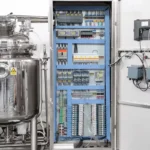
What is a fully automated CIP cleaning system? — for Grand homogenizing emulsifier
What tasks can filling and sealing machines accomplish?
Grand produces a range of filling and sealing machines designed to automate high-volume packaging tasks. Small jelly filling and sealing machines serve a surprisingly wide set of tasks across food, dairy, beverage and prepared-meal lines.
This article breaks down what these machines do, explains the two dominant architectures — rotary (rotating) filling & sealing machines and continuous (linear) filling & sealing machines — and helps you choose the right approach for jelly, yogurt, soy milk, pre-cooked bowls and similar products.
What a filling & sealing machine actually does
A filling and sealing machine performs a chain of tightly integrated operations on containers (plastic cups, bowls, trays, etc.):
• It places or indexes empty containers into a production track.
• It fills each container with a controlled volume of liquid, semi-liquid, paste or particulate product.
• It often performs product-level operations such as dosing, multi-nozzle filling, or product leveling.
• It applies a lid film, foil or plastic seal.
• It seals the lid to the container by heat, ultrasonic, impulse or cold-seal methods.
• It may code (date/lot), cool, and discharge finished packs onto conveyors for secondary packing.
For small jelly production, the machine controls fill volume precisely (important for weight-based regulation) and seals cleanly to maintain shelf life and hygiene.
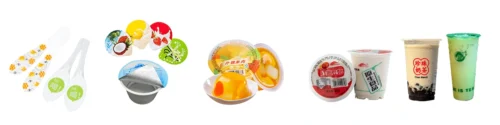
Typical applications for small jelly filling & sealing machines
You can use these machines for:
• Fruit jelly cups and single-serve desserts.
• Yogurt and fermented dairy products.
• Soy milk and plant-based beverages in cup format.
• Ready meals and pre-cooked bowls with broth or sauce.
• Cosmetic jars or gel samples in some adapted formats.
They handle both single-serve cups and multi-cavity trays. Your uploaded photos show a semi-automatic dual-output machine that fills two cups side-by-side — ideal for small-batch production, R&D or lines that require frequent mold changes.
Two main machine families: rotary vs continuous (linear)
The market centers on two architectures: rotary (rotating) filling & sealing machines and continuous (linear/continuous) pneumatic filling & sealing machines. Both can produce high-quality, hygienic seals — but their strengths and trade-offs differ.
Rotary (rotating) filling and sealing machines
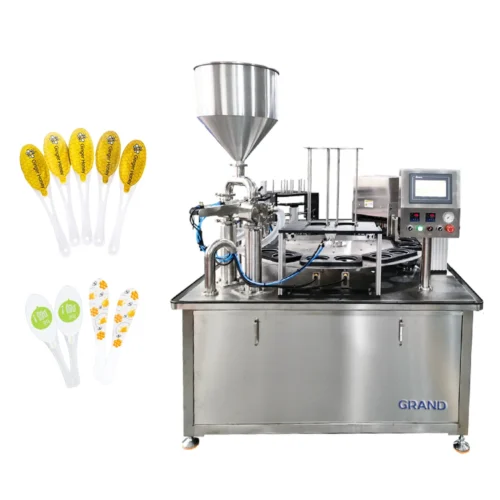
How they work — short: A circular turret holds containers. The turret indexes each pocket through stations in sequence: cup loading → filling → sealing film application → heat seal → coding/extraction.
Strengths
High throughput in a compact footprint. Turret systems achieve high cycles per minute because multiple stations work simultaneously.
Precise indexing. The mechanical rotation guarantees repeatable alignment for filling nozzles and sealing head, helping with tight tolerances for small diameters (5–10 mm beads aren’t the target here, but rotary excels at small cup positioning).
Integrated multi-step processing. You can easily combine filling, vacuum/modified atmosphere, sealing, and coding on one turret.
Good for sealed lids and complex seal processes. Heat-seal quality benefits from exact alignment.
Typical uses
Yogurt cups, pudding, fruit jelly single-serve cups.
Multi-nozzle filling for viscous products when accuracy per pocket matters.
Lines where product changeover stays within a known family of cup sizes.
Limitations
Tooling complexity. Mold changes can be fast if designed well, but a rotary turret often requires precise tooling and supplier support.
Cost. Rotary machines with many stations and high automation cost more upfront.
Maintenance. Turret bearings and indexing mechanisms need regular checks, especially in high-humidity or washdown environments.
Continuous (linear/pneumatic) filling and sealing machines
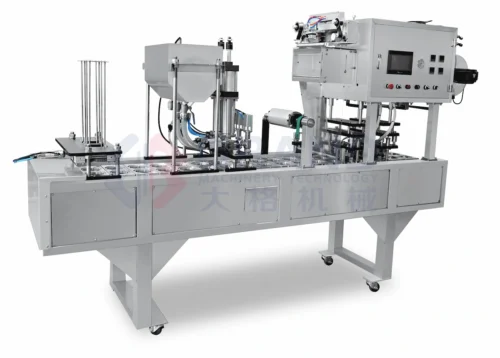
How they work — short: Containers travel in a linear conveyor lane. Filling heads or nozzles actuate as cups pass under them. A downstream sealing station applies and heats or ultrasonic-seals film while the conveyor continues.
Strengths
Flexibility and simplicity. Linear machines adapt easily to different container sizes by changing a few guides or molds. Your uploaded machine photos show this style — simple frame, easy access for mold swaps.
Lower initial cost for small-to-medium lines. They serve well where throughput requirements are moderate or where multiple product sizes require frequent changeovers.
Fast mold changeover (when designed for it). Many continuous machines use simple plate molds or fixture-based guides that operators can swap quickly.
Easier service and hygiene access. Open frame and modular stations simplify cleaning, CIP routines and maintenance — a big plus for European customers concerned with stringent hygiene standards.
Typical uses
Single-serve jelly cups, soy pudding, beverage cup filling, and bowl-mouth sealing when product flow is moderate.
Pilot lines and contract manufacturers with mixed product runs.
Limitations
Throughput ceiling. For extremely high-speed lines (tens of thousands of cups per hour), rotary often outpaces linear designs.
Sealing uniformity at very high speeds can be more challenging because timing depends on conveyor consistency and film tracking.
Which architecture should you choose?
If your priorities are high-volume production and minimal floor footprint, choose a rotary system.
If you need flexibility, straightforward mold swaps, easy maintenance and cost-efficiency for medium runs, choose a continuous (linear) system — especially for diverse SKUs or frequent format changes.
Your uploaded images show a compact, semi-automatic dual-output machine that demonstrates the continuous/linear approach: it supports simple mold replacement and works well for small jelly and yogurt lines that require variable formats and easy access.
Key specifications to evaluate (practical list)
When you select a filling & sealing machine for jelly and similar products, evaluate these:
Packing speed (cups/hour) — choose a machine that matches both current output and planned growth. (Example reference bands for continuous machines: ~800–7,200 cups/hour across different models; rotary machines can reach higher speeds per footprint.)
Number of filling heads / outputs — dual/nozzle vs multi-nozzle affects throughput and product shear on fragile gels.
Filling accuracy — ± weight or ± volume (critical for regulated food labels).
Sealing type — heat-seal, ultrasonic, induction; choose based on your lid material and barrier requirements.
Changeover time — how long to change molds and adjust filling volumes.
Hygiene features — CIP-friendly nozzles, stainless steel 304/316 contact parts, IP washdown rating.
Compatibility with container types — plastic cup, PP bowl, aluminum-lidded trays.
PLC & HMI controls — recipe storage for fast SKU change.
Air and power specs — European users must confirm voltage, frequency and compressed-air standards (e.g., 220–400 V options, 50 Hz).
Service & spare parts — local support reduces downtime.
Practical notes for European operators
European factories often face operational specifics that affect machine selection:
• Electrical and pneumatic differences. Confirm machine voltage (230 V vs 400 V three-phase) and air pressure compatibility (bar/psi). Grand machines typically ship configurable voltages but always confirm before buying.
• CE and food-safety compliance. Ensure the machine has CE marking and meets EU food-contact material standards for stainless steel and polymer seals.
• Hygiene and washdown protocols. EU inspectors expect easy-to-clean designs. Continuous machines with open frames and removable molds usually meet these expectations; specify 316 stainless in contact zones for aggressive cleaning regimes.
• Spare parts availability & service. European customers value local technicians or fast remote support. Ask the supplier about spare-part lead times and on-site training.
Why mold-change simplicity matters
For small-batch jelly lines and multi-SKU cosmetic runs, the ability to change molds quickly lowers downtime and increases SKU flexibility. Continuous machines often use simple, quick-release mold plates. In contrast, rotary machines can be quick too, but require precision alignment — so design matters.
Your photos show an easy-access sealing head and a platform where two cups sit side-by-side. That configuration minimizes changeover complexity and suits product R&D or seasonal runs.
Common extra features and useful options
• Vacuum / MAP sealing — extends shelf life for fresh dairy and prepared meals.
• Multi-layer film capability — needed for barrier films in high-fat or long-shelf products.
• Dosage options — piston filler, peristaltic pump, gravity or servo-driven volumetric filling depending on fluid viscosity.
• Coding/inkjet printers — for date/lot printing immediately after sealing.
• In-line checkweigher / metal detector — for QA compliance in food lines.
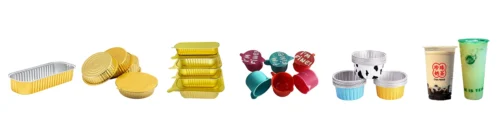
Case examples (typical line compositions)
Small yogurt cup line (medium throughput)
Linear filling station with piston filler → film application → heat-seal head → date coder → discharge.
Benefits: flexible, easy-clean, quick changeovers.
High-speed jelly cup line
Rotary turret with multiple filling heads → vacuum/film station → rotary heat-seal → cooling tunnel.
Benefits: high throughput and compact floor plan.
Prepared bowl (pre-cooked meal)
Linear heavy-duty filler for viscous sauces → film application → impulse seal with high-temp control → secondary pack.
Benefits: robust sealing for thicker products and larger containers.
Final selection checklist
Before you buy, clarify:
• Product viscosity & particulates (fruit pieces, seeds).
• Target cups/hour and future growth.
• Number of SKUs and required changeover frequency.
• Required certifications (CE, HACCP).
• After-sales support expectations in your country.
If you want, provide: product photos, cup dimensions, target hourly output and the types of lids/films you plan to use. With those I can suggest a model family (rotary vs continuous), estimate cycle times and list the must-have options.
Frequently Asked Questions
Develop Your Business with Grand