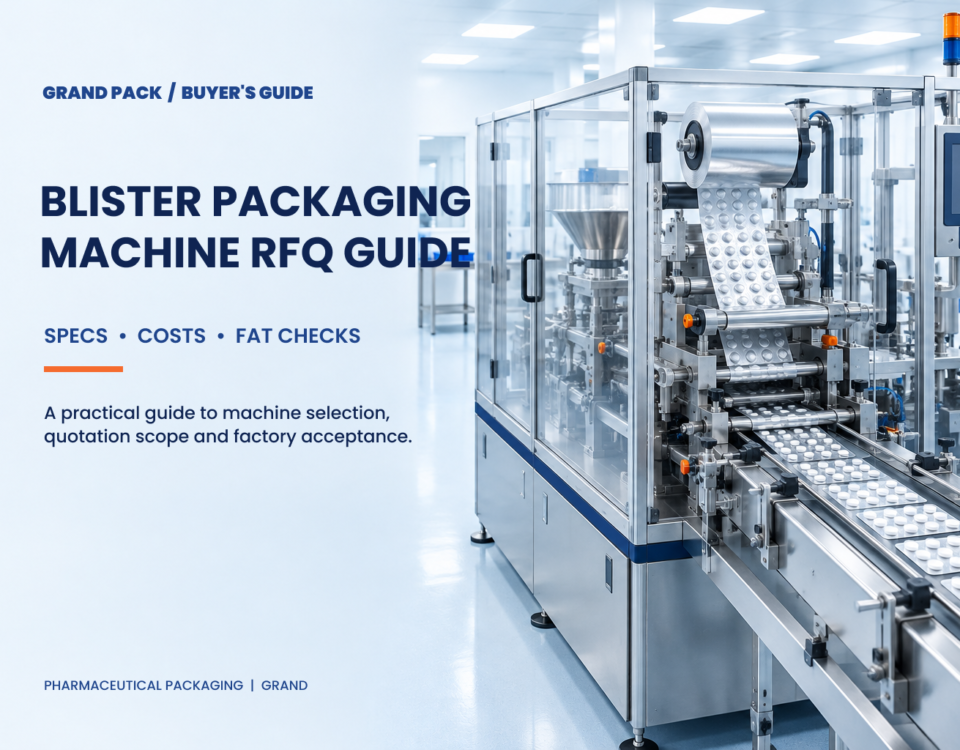
Blister Packaging Machine RFQ Guide: Specs, Costs & FAT Checks
Small Blister Pack Machine for Labs and Small Batches: A Practical Selection Guide
(Last Updated: Nov. 16th)
Quick Answer: A small blister pack machine is a compact forming, sealing, and die-cutting system built for pharmaceutical formulation labs, stability trials, clinical supplies, hospital pharmacies, and low-volume specialty production. In equipment sourcing, "small" rarely means a smaller finished blister card. Instead, it refers to a compact machine footprint, small-batch throughput requirements, or a simplified mechanical scale. Buyers should match their product geometry, barrier film structure, and required accepted cards per hour to either a benchtop unit or a compact automatic machine.
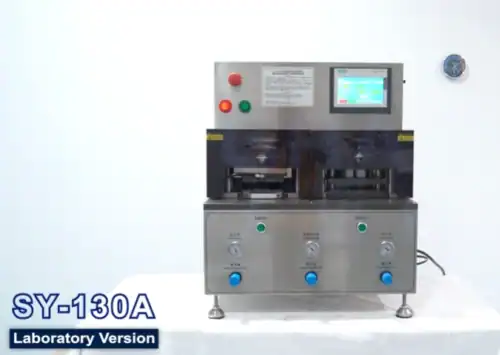
GRAND DG-130 benchtop blister pack machine for laboratory R&D and small-batch packaging
1. What Is a Small Blister Pack Machine?
Procurement engineers searching for a small blister pack machine are usually solving a scale mismatch. Industrial blister lines can occupy substantially more production space and require longer setup, material threading, and line-clearance work. For short stability or clinical batches, compare that setup burden with the actual accepted-output requirement before choosing the larger machine.
Depending on mechanical structure, suppliers describe small-scale equipment as a laboratory blister machine, a benchtop blister packaging machine, a desktop blister packing machine, or a mini blister packing machine.
Unpacking "Small": Footprint, Batch Size, and Machine Scale
Clarify which meaning of "small" governs your project before requesting quotes:
Small machine footprint: Compact enough to pass through standard lab doors, fit inside service elevators, or sit on a reinforced bench without cleanroom expansion.
Small batch volume: Runs of tens, hundreds, or a few thousand blister cards per lot, where minimal setup waste and fast cleaning outweigh peak cycle speed.
Small equipment scale: Standalone units performing core blister steps—forming, loading, heat sealing, batch coding, and cutting—without inline cartoners or robotic transfer linkages.
Importantly, a small machine does not mean a smaller blister card. Provided the card fits inside the station’s maximum forming window, a compact unit produces standard pharmaceutical blister cards and deep-pocket layouts.
How Small Units Differ from Industrial Blister Lines
Industrial lines unwind heavy film reels, index the web via servo drives, feed dosage units automatically at high cycle rates, and transfer packs to inline cartoners. Small-scale machines reduce footprint and cost by consolidating stations, narrowing web width, or using operator-tended sheet transfer and hand-filling.
2. When Is a Small Blister Machine the Right Choice?
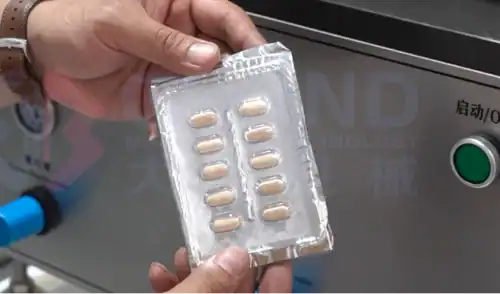
Precision-molded aluminum-plastic (Alu-PVC) blister samples for formulation and stability trials
Choosing a small batch blister packaging machine balances operator labor against format agility. In low-volume work, changeover and cleaning speed matter more than strokes per minute.
Formulation R&D, Stability Batches, and Clinical Supplies
A benchtop or compact small-batch unit fits best when your operation focuses on:
Formulation R&D: Screening how tablets or capsules interact with thermoformed PVC/PVDC versus cold-formed aluminum laminates using minimal film.
ICH stability and registration batches: Producing representative sealed packs for product-specific stability studies. The relevant container-closure suitability, material compatibility, and integrity requirements depend on the dosage form and regulatory context; FDA guidance on container closure systems discusses these considerations.
Clinical trial materials (CTM): Packaging small lots of blinded or multi-strength patient kits with frequent lot-code and tooling changes.
Hospital pharmacies and compounding rooms: Potential unit-dose or packaging trials where applicable quality requirements permit. Verify the actual machine noise level, electrical supply, footprint, and qualification needs for the facility.
Pilot nutraceutical launches: Testing market demand in short commercial runs before investing in a dedicated high-speed line.
When a Small Blister Machine Is the Wrong Fit
Step up to a larger automatic machine when:
Sustained commercial volume dominates: Requiring tens of thousands of accepted cards per shift makes manual cavity loading or low-speed indexing uneconomical.
Pack dimensions exceed the forming window: Multi-syringe trays or wide cards exceeding a compact platen area require a wider-web machine.
Inline downstream automation is required: Projects needing automated vision rejection linked directly to a cartoner belong on an industrial line from the GRAND blister packaging machine category catalogue.
3. Benchtop vs. Compact Automatic Blister Machines
Buyers typically compare two equipment architectures:
Benchtop / Desktop Manual or Semi-Automatic Units: Operator-tended machines where pre-cut film sheets or short web strips are formed, hand-filled, covered with lidding foil, heat-sealed, and die-cut across modular stations. Sepha’s EZ Blister+ documentation shows how tabletop 3-in-1 units separate forming, heat sealing, and cutting into distinct stages for low-volume batches.
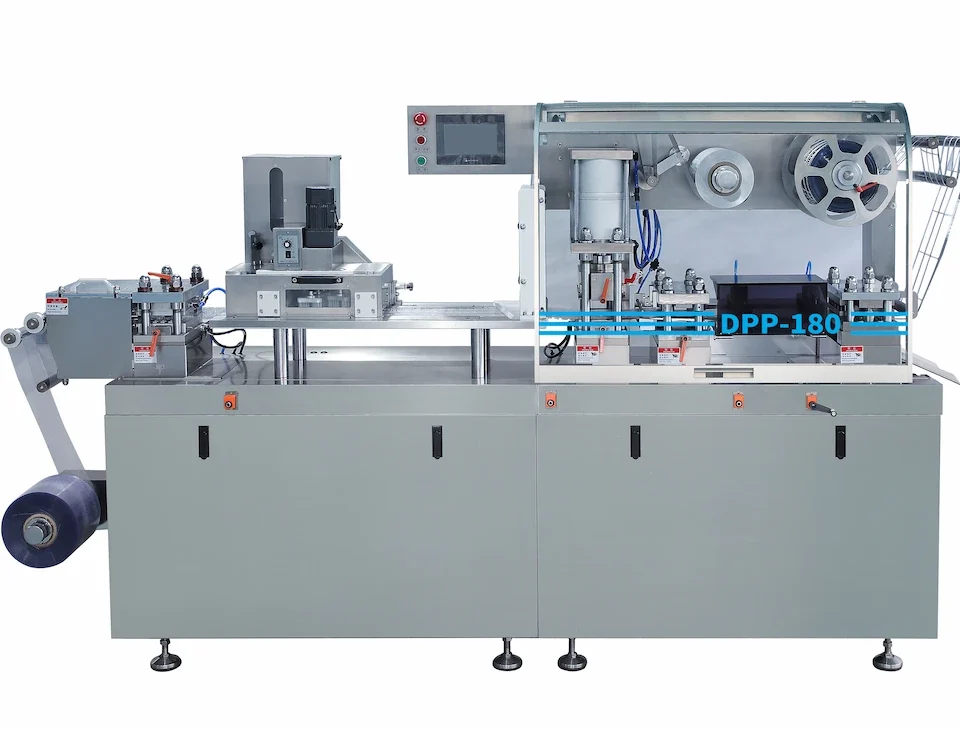
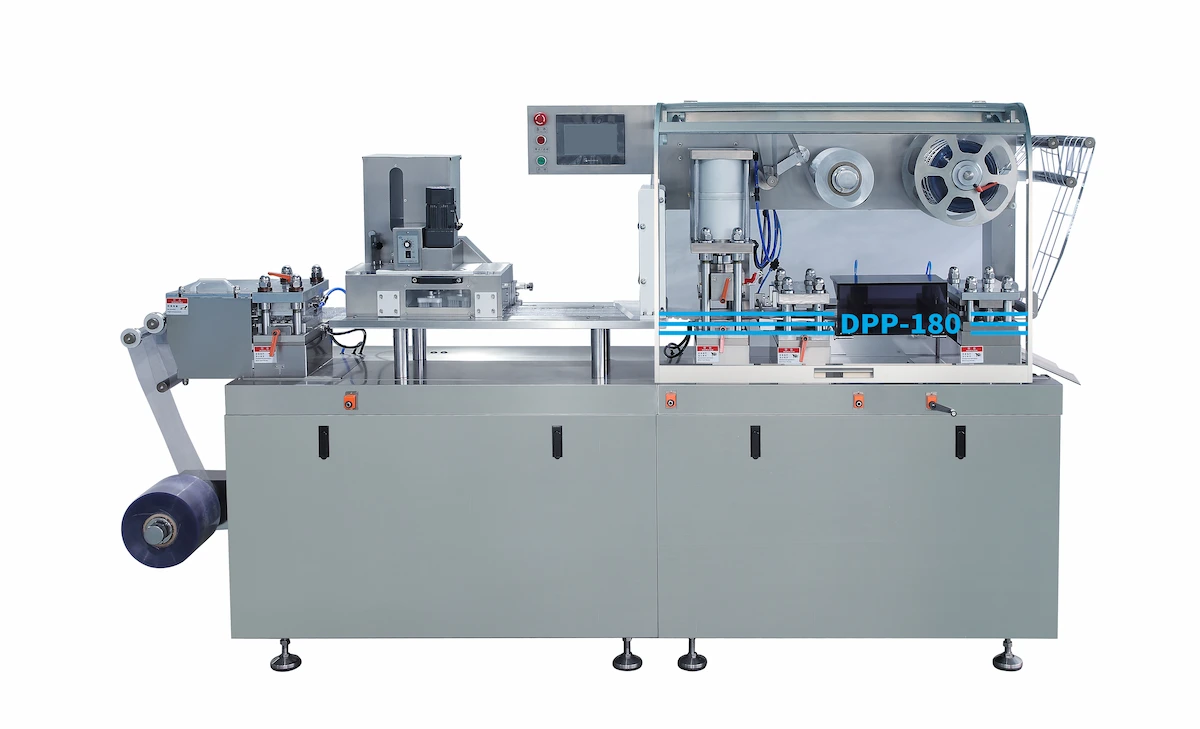
Compact Automatic Blister Machines: Entry-level roll-fed floor units—such as the DPP-80 or DPP-100 tablet blister packing machine in the GRAND blister packaging machine portfolio—that unwind coiled film and foil, indexing the web automatically through heating, forming, feeding, sealing, coding, and punching stations.
Table 1: Benchtop Manual/Semi-Auto vs. Compact Automatic Comparison
| Comparison Dimension | Benchtop / Desktop (Manual or Semi-Automatic) | Compact Automatic Blister Machine (Roll-Fed) | Buyer Verification Focus |
| Machine Footprint | Bench or compact-stand format; as a documented example, DG-130 lists 635 × 575 × 710 mm and 115 kg. Verify the quoted revision. | Floor-standing format requiring aisle and maintenance clearance. Dimensions and machine weight vary substantially between DPP models; use the exact layout drawing. | Check door widths, elevator capacity, and maintenance access. |
| Automation Level | Operator-sequenced forming, hand-loading, platen sealing, and die cutting. | Automated roll unwind, web indexing, forming, mechanical feeding, sealing, coding, and punching. | Confirm which stations are motorized/pneumatic and which require manual action. |
| Operator Involvement | Continuous hands-on sheet transfer and manual cavity loading. | Supervisory operation: loading reels, refilling hoppers, and monitoring quality. | Base output calculations on sustainable operator pacing, not single-cycle tests. |
| Batch Suitability | Micro-batches, R&D trials, stability lots, and clinical runs (dozens to a few hundred cards) with minimal startup film waste. | Small-to-medium commercial batches where continuous web threading is justified by run length. | Weigh roll-threading film loss against manual labor hours per batch. |
| Format Changeover | Few format parts (forming mold, sealing plate, cutting die); no feeder tracks or web-index cams to re-time. | Requires swapping forming, sealing, and punching tools plus feeder tracks and index settings. | Request a complete change-part list per SKU and define changeover start-to-finish criteria. |
| Typical Applications | Formulation labs, stability testing, clinical supplies, hospital pharmacies, and multi-shape prototypes. | Entry-level commercial tablet/capsule runs, contract packagers, and pilot production lines. | Align equipment class with your 12-to-24-month batch schedule. |
Note: Specific cycle rates, changeover times, and configurations vary by model revision and must be confirmed in your supplier quotation.
4. Seven Specifications to Check Before Buying
Catalogue brochures provide nominal boundaries, not project guarantees. Verify these seven specifications before ordering.
Table 2: Seven-Point Technical Verification Checklist
| # | Specification to Check | What to Define and Verify | Risk if Overlooked |
| 1 | Product Dimensions & Samples | Tablet/capsule length, width, thickness, weight, tolerances, and capsule code (00#–3#). | Shallow pockets, crushed tablet edges at sealing, or feeder jams. |
| 2 | Finished Blister Layout | Card dimensions (mm × mm), cavity pitch, units per card, perforations, and batch-code margin. | Card layout or multi-card die exceeds usable heating, sealing, or cutting area. |
| 3 | Forming & Lidding Materials | Forming web grade/thickness (PVC, PVDC, PET, or cold-form Alu) and lidding foil (PTP Alu, paper-Alu, dialysis paper). | Thermoforming-only setups cannot cold-form Alu-Alu without dedicated tooling and force. |
| 4 | Forming Area & Depth | Maximum forming window (mm × mm) and maximum draw depth (mm) stated separately for plastic and cold-form Alu. | Deep cavities thin out or pinhole at corners if draw depth exceeds material limits. |
| 5 | Required Accepted Output | Target output stated in accepted finished blister cards per hour for a defined cavity count. | Confusing grains/hour or empty cycles/min with usable card output causes severe capacity shortfalls. |
| 6 | Utilities & Installation | Voltage, phase, kW load, compressed air pressure (MPa) and flow (m³/min), plus cooling water needs. | Undersized lab air compressors cause pressure drops that weaken forming and sealing. |
| 7 | Tooling, Inspection & Documentation | Included mold sets, embossing type, inspection method, English manuals, schematics, and FAT protocol. | Unbudgeted tooling charges, missing documentation, or unverified seal integrity at delivery. |
Thermoforming vs. Cold-Forming Limits
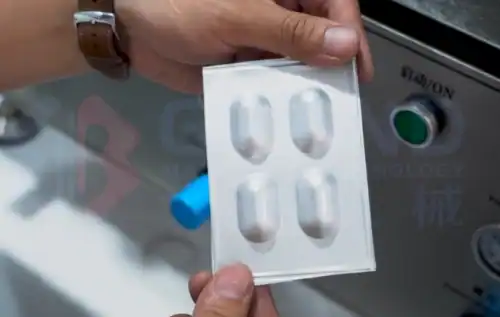
High-barrier cold-formed aluminum (Alu-Alu) and thermoformed plastic blister packs
In industry evaluations—such as Uhlmann’s overview of pharmaceutical blister machines—forming method, format area, draw depth, and sealing principle (platen vs. rotary) are independent variables. Cold-forming aluminum (Alu-Alu) uses mechanical stamping, whereas thermoforming softens plastic film before cavity formation. The maximum attainable depth depends on material, tooling, and the specific machine configuration. Moreover, cold forming only shapes the pocket; lidding foil is still bonded by heat sealing. Confirm both forming depth and sealing parameters for each material combination.
5. How Does a Small Blister Packaging Machine Work?
Whether a machine uses pre-cut sheets or roll stock, blister packaging follows six stages. Document forming, sealing, and cutting settings and verify the finished package against product-specific quality and integrity requirements. Standards for terminally sterilized medical-device packaging should not be assumed to apply automatically to pharmaceutical tablet blister packs.
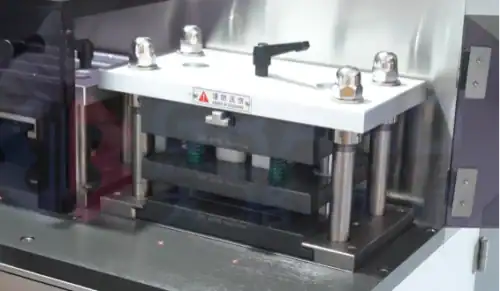
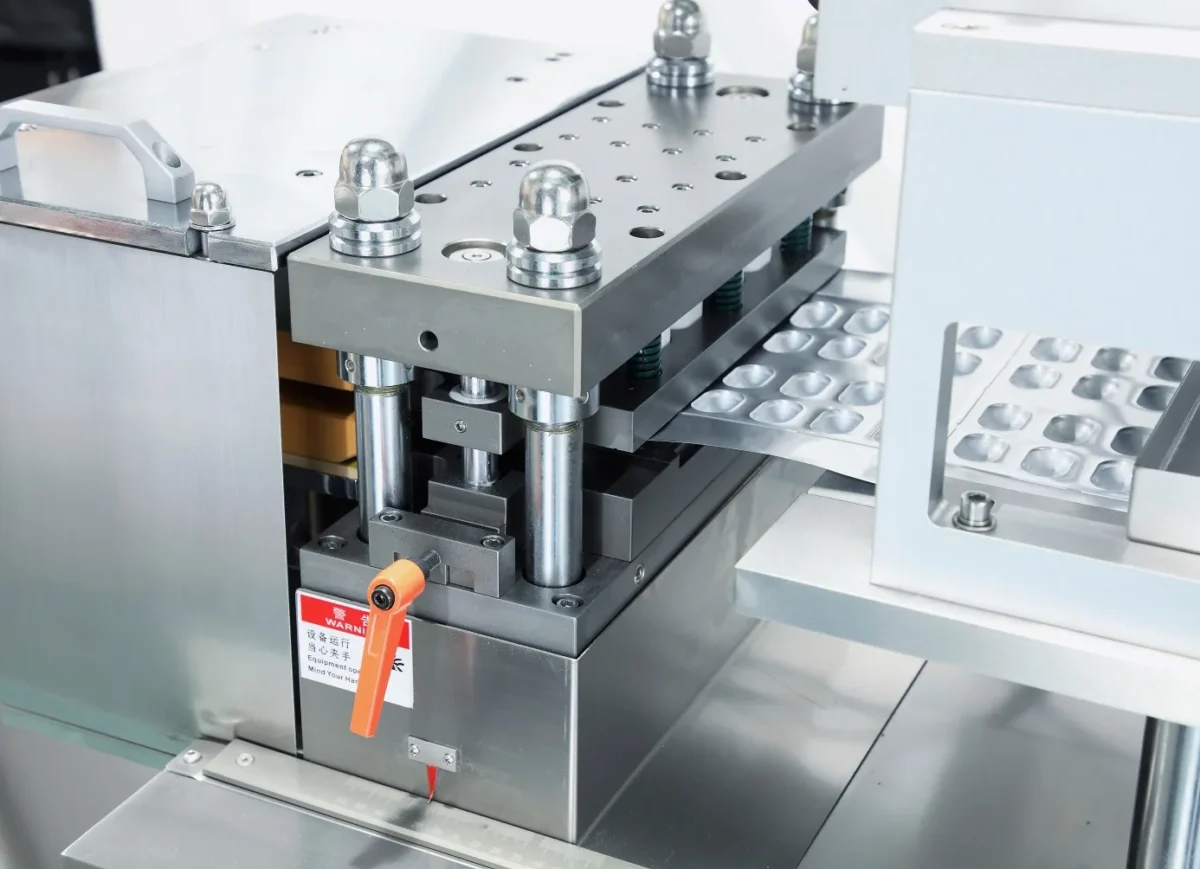
Platen heat-sealing station bonding lidding foil to formed blister cavities
The Six-Stage Blister Workflow
Material Preparation: Forming film and lidding foil are prepared as pre-cut sheets on benchtop units or threaded from reels on compact automatic machines while heaters stabilize.
Forming: In thermoforming, heated plates soften plastic film and positive compressed air forms uniform cavities inside the mold. In cold forming, a mechanical punch stamps aluminum laminate into the female die without web pre-heating.
Product Loading: Tablets or capsules are placed into formed pockets—by hand on a laboratory blister machine (allowing rapid switching across 00#–3# capsules and custom tablets) or via vibratory/brush feeders on automatic units.
Sealing: Heated platen or rotary stations apply controlled temperature, pressure, and dwell time to bond the lidding foil across the blister land area while embossing batch codes if fitted.
Cutting: A precision die or punching station trims the sealed sheet or web into individual blister cards and separates the waste skeleton.
Inspection: Operators or inline sensors check cavity fill, seal continuity, code legibility, and trim accuracy against agreed acceptance criteria, supported by offline leak tests.
Process Workflow and Configuration Scope
Across this generic six-stage workflow (Material Preparation → Forming → Product Loading → Sealing → Cutting → Inspection), actual station integration and automation methods depend on the selected model and quoted options. Buyers should always review the mechanical layout drawing and station sequence for the exact machine build they are purchasing.
6. GRAND DG-130: A Laboratory-Scale Example
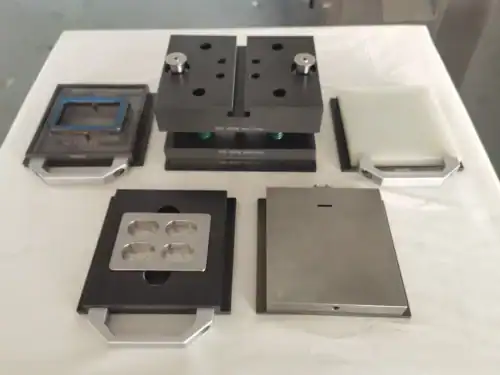
Interchangeable custom molds for the GRAND DG-130 laboratory blister machine
The GRAND DG-130 Laboratory Blister Pack Machine—also featured in GRAND’s post on the laboratory blister machine for R&D—illustrates how a benchtop unit is specified for formulation labs, hospital preparation rooms, and small-batch trials.
Application Positioning and Catalogue Specifications
On the GRAND website, the DG-130 is positioned as a desktop unit for forming, heat-sealing, batch-numbering, and cutting aluminum-plastic (Alu-PVC) and aluminum-aluminum (Alu-Alu) blister packs for capsules (00#–3#) and tablets. Published catalogue figures on the DG-130 product page and the GRAND blister packaging machine category table list:
Applicable Materials: Aluminum-plastic and Aluminum-alu (with PVC hard film, PTP aluminum foil, and dialysis paper listed in the category table).
Stated Productivity: 200–700 grains/hour (200–700 units/hour in the blog post).
Maximum Forming Area & Depth: 110 mm × 120 mm; up to 14 mm depth (Alu-PVC) and 10 mm (Alu-Alu).
Utilities: 220V, 2.6 kW total power; compressed air at 0.4–0.6 MPa and 0.2 m³/min (the category table also lists 0.75 kW main motor power, 35–75 mm stroke range, and tap/recycle water cooling under the manual column).
Dimensions, Weight & Noise: 635 mm × 575 mm × 710 mm, net weight 115 kg, noise <75 dBA.
Four Points to Confirm in Your Engineering Quotation
Published website specifications are starting reference points, not engineering-approved contract commitments. Before ordering a DG-130, confirm four details with GRAND engineers:
Manual vs. Semi-Automatic Operation: Confirm which forming, sealing, and cutting steps are operator-controlled and which are automated on the quoted DG-130 revision. Request the actual operating sequence and electrical bill of materials, including any HMI or PLC supplied.
Output in Blister Cards/Hour: Because 200–700 grains/hour counts individual dosage units, ask how many finished cards per hour an operator can complete with your specific cavity count.
Seal Integrity Testing: Define an objective seal-integrity test, sampling plan, and pass/fail criteria for your actual forming and lidding materials before the agreed trial or FAT. Catalogue percentages alone are not an acceptance report.
GMP and Regulatory Scope: Website mentions of "GMP requirements" refer to cleanable construction and material selection—not automatic FDA certification or 21 CFR Part 11 electronic records compliance.
7. Common Small-Blister-Machine Selection Mistakes
Watch out for these five sourcing mistakes when comparing small blister machines:
1. Confusing Grains/Hour with Blister Cards/Hour
Catalogue tables often mix units: GRAND’s category table lists 200–700 grains/hour for manual packaging alongside plates/hour, plates/min, and times/min (punches/min) for automatic models. Always convert to finished cards:
Cards/Hour = Cycles/Min × Cards/Cycle × 60
Units (Grains)/Hour = Cards/Hour × Units/Card
At 10 tablets per card, 200–700 grains/hour equals 20 to 70 blister cards per hour.
2. Choosing Equipment Only by Headline Speed
High cyclic speed does not reduce batch cost if format changeovers and web registration consume hours of setup time and waste expensive foil on short runs.
3. Ignoring Material Compatibility and Pneumatic Supply
Switching between Alu-PVC and Alu-Alu requires dedicated forming tooling and adjusted parameters. Positive-pressure forming and platen sealing also rely on stable air pressure and flow. As Festo’s engineering guide on pneumatic pressure and monitoring explains, supply pressure (MPa) does not guarantee actuator force if flow drops occur across undersized compressors or regulators.
4. Overlooking Tooling Requirements
Each blister layout or capsule size requires matched forming, sealing, and cutting tooling. Confirm how many format sets are included in the base quote.
5. Failing to Define Acceptance Criteria
Define acceptable pocket thickness, flat seal margins, batch code legibility, and leak-test criteria before ordering so pre-shipment testing has clear pass/fail benchmarks.
8. What to Include in Your RFQ
Sending a structured application package helps GRAND engineers recommend whether a benchtop unit like the DG-130 or a compact automatic model from the DPP series fits your project. Include:
Product details and samples: Dosage form, dimensions (L × W × Thickness), capsule size code, weight, and physical samples.
Blister card layout: Card dimensions (mm × mm), cavity arrangement, units per card, perforations, and coding area.
Packaging material specs: Forming web type/thickness (PVC, PVDC, or cold-form Alu) and lidding foil structure (PTP Alu, peelable foil, or dialysis paper).
Target accepted output: Required good blister cards per hour, batch size, and acceptable manual handling level.
Available utilities and space: Voltage/frequency, compressed air pressure and flow capacity, cooling water access, and bench/room dimensions.
Inspection and documentation: Required manuals, electrical schematics, material certificates, and sample trial or FAT expectations.
For a full breakdown of quotation scope tables and pre-shipment testing protocols, see our Blister Packaging Machine RFQ Guide: Specs, Costs & FAT Checks.
9. Frequently Asked Questions
1. Can one small blister pack machine run both Alu-PVC and Alu-Alu?
Yes, if the quoted configuration supports both thermoforming (for plastic webs) and cold forming (for aluminum laminates). However, switching materials requires dedicated forming molds—since cold-formed aluminum pockets require different cavity geometry and shallower draw depths—plus adjusted heating and sealing settings.
2. How do I convert grains/hour or cycles/minute into blister cards/hour?
If a machine is rated in grains/hour (individual tablets or capsules per hour), divide by the number of cavities per card (500 grains/hour ÷ 10 cavities = 50 cards/hour). If rated in cycles/minute (punches/min), multiply cycles per minute by cards punched per cycle, then multiply by 60 for theoretical cards per hour.
3. Does a benchtop blister packaging machine need compressed air and water cooling?
Some pharmaceutical benchtop units require clean, dry compressed air (for instance, the DG-130 catalogue page lists 0.4–0.6 MPa at 0.2 m³/min) to actuate forming and sealing presses. Some configurations also use tap or recirculating cooling water. Verify utility connections before installation.
4. How do manual, semi-automatic, and compact automatic blister machines differ?
Manual and semi-automatic benchtop units rely on an operator to position film sheets, hand-load products into formed pockets, and move trays between forming, sealing, and cutting stations while heaters and timers are controlled via buttons or an HMI. Compact automatic machines unwind roll stock and index forming, feeding, sealing, and punching continuously.
5. Can small blister machines form deep pockets for large capsules or ampoules?
Yes, within the station’s draw limits. The DG-130 lists maximum forming depths of 14 mm (Alu-PVC) and 10 mm (Alu-Alu) inside a 110 mm × 120 mm area, while compact floor models such as the DPP-80 or DPP-100 have model-specific forming windows and tooling options. Do not transfer forming-depth figures between models; confirm the current product-page specification and quotation for the exact configuration. Submit 3D product dimensions for cavity review.
6. Does buying a laboratory blister machine guarantee GMP or 21 CFR Part 11 compliance?
No equipment purchase guarantees regulatory compliance on its own. Hygienic stainless-steel construction and repeatable controls support GMP operations, but cGMP qualification and 21 CFR Part 11 electronic record controls depend on the quoted PLC/HMI package, validation documentation, and your site’s quality management system.
Conclusion and Next Steps
Selecting the right small blister pack machine starts with separating machine footprint from finished pack dimensions, converting headline speed into accepted blister cards per hour, and matching automation level to your batch size and changeover frequency.
Ready to evaluate a benchtop or compact automatic solution for your facility? Send your application package to GRAND—including your product dimensions, physical samples, blister drawings, packaging material specifications, required accepted output, and site utility requirements—and contact the GRAND engineering team for a technical suitability review and configuration-specific quotation.
Develop Your Business with Grand